A Corporate Guest Chose Una for Every Future Booking. Here's What Changed.

After several weeks of using Una by Polydom in live operations, Avaneo Hotels received an encouraging piece of feedback.
One of its corporate clients had used Una's booking widget and liked the experience enough to decide that future reservations would be made exclusively through that channel.
For us, that was a meaningful milestone.
Not because the AI had answered another question or demonstrated another feature.
Because a real corporate customer had found the booking experience useful enough to choose it again.
A booking workflow becomes valuable when it makes life easier for both the hotel team and the person making the reservation.
That is the business outcome behind Una's July 2026 release: expanding what an AI Digital Employee can accomplish inside Apaleo, particularly for corporate and multi-room reservations.
The update introduced support for negotiated company rates, multiple rooms with individual guest details, group payments, guarantee-aware payment handling, automatic cancellation of eligible unpaid reservations, and reservation creation from supported phone and email inquiries.
Together, these capabilities address work that has traditionally required reservations employees to move between conversations, company records, payment conditions, and booking systems.
Why Corporate Reservations Create More Work Than Ordinary Bookings
A leisure traveler usually books a room for themselves or their family.
A corporate reservation may involve an entirely different arrangement.
The traveler books under a negotiated company rate.
The company may be responsible for payment.
Several colleagues may need rooms for the same dates.
Each room may need to be associated with a different guest.
The reservation may use a specific guarantee type.
Payment conditions may depend on the company agreement rather than the standard public rate.
What appears to be one booking request can involve multiple commercial and administrative decisions.
For hotel reservations teams, this creates repetitive work.
An employee may need to identify the correct corporate account, verify the applicable rate, check room availability, collect individual guest details, select the correct payment arrangement, and create the reservation records.
When several rooms are involved, those steps become more complicated.
And if an inquiry arrives by phone or email, the employee may need to transfer information manually into the PMS.
This is why corporate reservation automation requires more than a conversational assistant that can explain room prices or send a booking link.
The challenge is to complete the eligible booking steps correctly while respecting the hotel's existing commercial rules.
The goal is not to make corporate bookings sound simple. It's to make the work behind them more manageable.
A Corporate Customer Chose Una's Booking Widget
The most encouraging feedback about the release came from Avaneo Hotels, one of the properties already using Una in production.
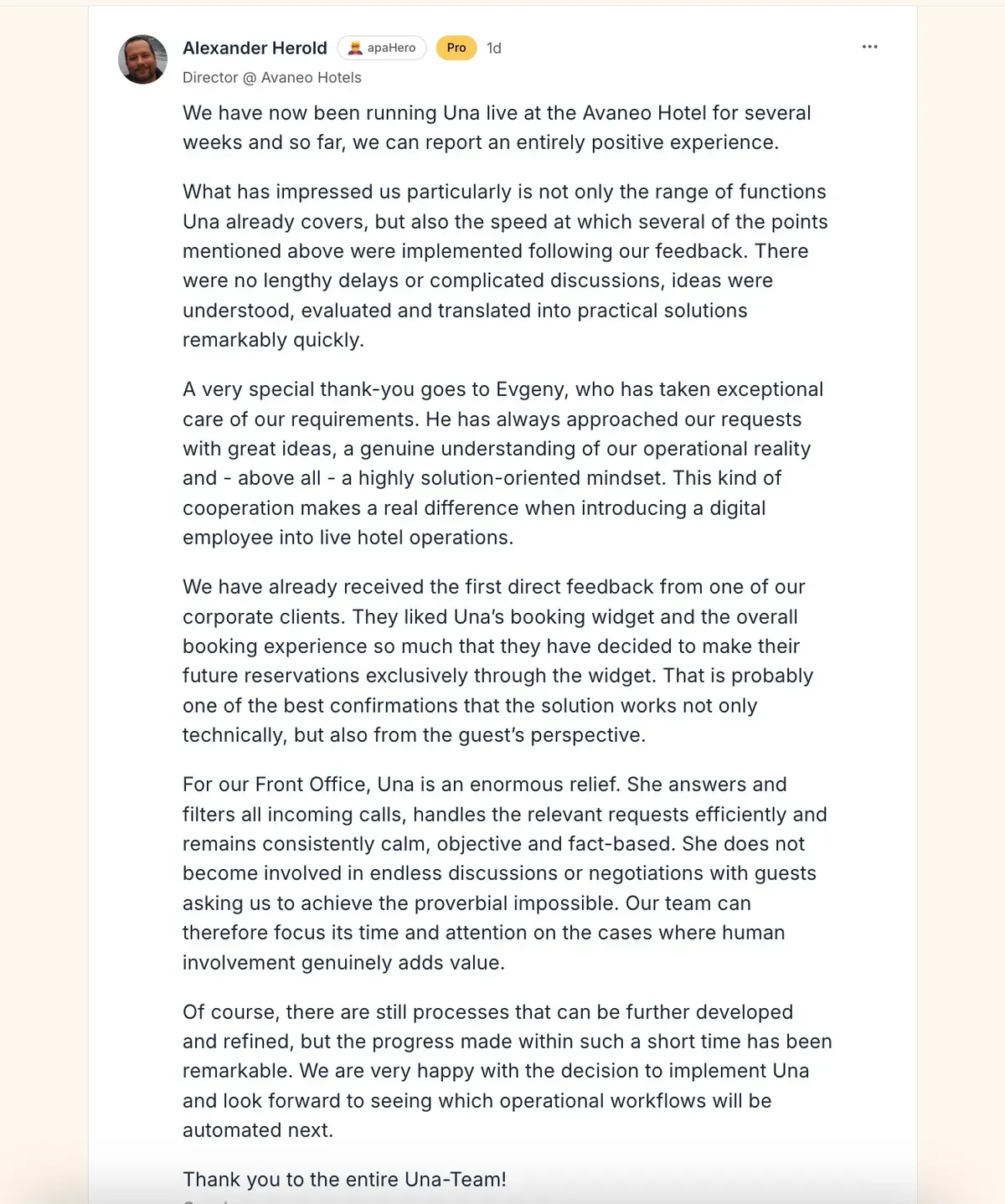
Alexander Herold, Director at Avaneo Hotels, shared feedback after several weeks of live operation.
Among the observations was the experience of one of Avaneo's own corporate customers.
Following the introduction of the corporate booking workflow, the customer used Una's booking widget and reported such a positive experience that they decided to use it for future reservations.
It's important to describe what this feedback demonstrates—and what it doesn't.
It is a customer-reported example of one corporate client's preference, not evidence that every corporate guest will adopt the same channel or that booking conversion has increased by a measurable percentage.
But the observation matters because it describes actual customer behavior.
The client wasn't simply impressed by a demonstration.
They had experienced the booking process and wanted to use it again.
For Avaneo, that suggested Una was becoming more than a way to reduce routine reservations work. It was also providing a booking experience that a corporate customer preferred.
You can explore the broader implementation in our Avaneo Hotels customer story.
What's New: Six Reservation Workflows in Apaleo
The July release expanded Una's supported operational capabilities inside Apaleo.
The changes focus on practical reservation scenarios rather than standalone AI features.
1. Corporate Reservations Using Company Codes or Names
Corporate travelers don't always know the booking code associated with their employer.
Some know only the company name.
Others may be booking on behalf of colleagues.
Una's updated workflow supports corporate reservation inquiries using company codes or company names, allowing the booking process to follow the applicable company account and rate information available through Apaleo.
The distinction matters because a corporate rate is part of a commercial agreement, not simply a discount that should be available to anyone who mentions an organization.
The workflow must use the hotel's configured rate eligibility, company records, and authorization rules.
Where the appropriate company or entitlement cannot be established, the request may require clarification or human review.
For hotels with a substantial share of corporate business, handling more of these inquiries through the correct reservation path can reduce repetitive manual work.
2. Multi-Room Reservations With Individual Guest Details
A corporate booker may need three, five, or ten rooms.
Those rooms may be assigned to different travelers.
Each guest may have separate personal information, arrival requirements, or booking details.
Una's multi-room workflow supports the creation of reservations with individual guest details through the connected Apaleo environment.
This reduces the need to manually reconstruct a multi-room request from a phone call or email.
It also helps preserve an important distinction: a corporate group request may be initiated by one person, but the resulting accommodation records still need to reflect the travelers and conditions involved.
The practical benefit is more consistent handling of eligible multi-room inquiries.
3. Payment Handling Based on Apaleo Guarantee Types
One corporate reservation may require prepayment.
Another may use a card guarantee.
A third may follow a permitted corporate payment arrangement.
Those conditions cannot be treated interchangeably.
Una's updated payment workflow uses supported Apaleo guarantee types to determine the appropriate payment handling for eligible reservations.
The goal is to apply the property's configured booking conditions rather than use the same payment request for every guest.
This is especially important for corporate accounts, where an inappropriate payment demand can create unnecessary friction or a reservation that does not comply with the agreed terms.
The payment workflow still depends on the relevant integration, configuration, and authorization conditions.
4. Automatic Cancellation of Eligible Unpaid Reservations
Unpaid reservations can create additional follow-up work for hotel teams.
Employees may need to review payment status, determine whether a booking has passed its payment deadline, and apply the appropriate cancellation policy.
Una's July update introduced automatic cancellation handling for unpaid reservations under supported conditions.
This does not mean every unpaid reservation should be canceled automatically.
Cancellation must follow the applicable rate conditions, payment rules, and property configuration.
When those requirements are correctly defined, automation can help reduce the manual effort involved in enforcing established reservation policies.
5. Group Payments Using a Single Payment Method
A company booking several rooms may want to pay for them together.
Without an appropriate workflow, that can create additional coordination between the reservations team and the person arranging payment.
The updated Apaleo workflow supports eligible group reservations using a single payment method.
This allows supported multi-room booking scenarios to be handled under the relevant group payment arrangement rather than requiring the booker to navigate a separate payment process for each room.
The exact behavior depends on the property's payment configuration and the supported reservation conditions.
For corporate bookers, the potential benefit is a simpler payment experience.
For hotel teams, it is fewer repetitive payment-related steps.
6. Reservation Creation From Phone and Email Inquiries
Corporate customers don't always start their booking journey on a website.
Some call the hotel.
Others email their requirements.
Those inquiries often contain the information needed to begin a reservation but traditionally require an employee to transfer the details into the PMS.
The July release expanded Una's ability to create supported reservations from phone and email interactions.
That matters because it brings the booking workflow closer to the channels corporate guests already use.
A caller can discuss requirements with Una, while the supported reservation process can proceed through the connected system.
Likewise, an eligible email inquiry can move toward reservation creation without every detail needing to be re-entered manually.
These actions remain subject to the property's booking rules, the information available, and the integration's supported functionality.
Why the Combined Workflow Matters More Than Any One Feature
Each capability solves a specific operational problem.
But the larger benefit comes from allowing several of those steps to work together.
Consider a corporate booker requesting four rooms for colleagues.
The inquiry arrives by phone.
The booker provides the company's name rather than its internal rate code.
The rooms need to be associated with four different travelers.
The company has an agreed rate and a specific payment arrangement.
A conventional process may require an employee to identify the company account, retrieve the rates, check the rooms, collect the guest names, prepare the bookings, and coordinate payment.
With the appropriate configuration, Una can support several of those steps through Apaleo.
The workflow can use the company information, check the relevant booking conditions, handle supported multi-room reservation details, and proceed according to the permitted guarantee and payment rules.
If something falls outside the configured process, a person may still need to intervene.
The operational opportunity is not that AI eliminates every exception.
It's that employees no longer need to personally perform every predictable step in an eligible corporate booking.
One less manual task is useful. A booking that moves through several authorized steps without repeated staff intervention is more valuable.
Building Around the Way Hotels Actually Operate
One of the most important principles behind the release is that Una doesn't need hotels to abandon their existing reservation policies.
She is designed to work through compatible systems and follow configured business rules.
In the Apaleo environment, that means respecting the relevant rate plans, reservation conditions, company records, and supported guarantee logic.
For operators, this is an important consideration.
Corporate reservations already involve negotiated agreements and established procedures.
Adding AI should not mean creating a parallel booking process that employees must supervise and reconcile manually.
The stronger approach is to automate appropriate steps within the rules that govern the property.
Of course, those rules and records need to be accurate.
Outdated company information, incorrect rate configurations, or ambiguous payment instructions can undermine an automated workflow just as they can a manual one.
That makes preparation and ongoing review an essential part of implementation.
Customer Feedback Is Shaping What Una Can Do
The July release wasn't developed in isolation.
As the original announcement explained, many of Una's operational improvements grew out of customer feedback and real hotel workflows.
That feedback is particularly valuable because real reservation inquiries rarely follow a perfect demonstration script.
A company booker may change the number of rooms.
A traveler may not know the correct corporate code.
Payment conditions may differ from the standard booking flow.
The guest may begin by phone and need the remaining booking steps handled through another channel.
These are the situations that reveal whether an automation is genuinely useful to the hotel team.
They also help determine which workflows should be expanded, refined, or escalated to employees.
Avaneo's experience is an example of this development process.
Live operation provided feedback about how Una handled real booking requirements, while the response from a corporate client offered a different perspective: the experience of the person actually making the reservation.
Both matter.
A reservation workflow should reduce work for the hotel without introducing unnecessary difficulty for the customer.
What This Release Means for Hotel Operators
For hotels that rely on corporate accounts, reservations work is not limited to selling a room.
It includes maintaining negotiated terms, processing multiple guests, applying the correct payment arrangements, and ensuring the resulting bookings are recorded accurately.
These responsibilities can consume a meaningful amount of Front Office and reservations-team time.
Una's expanded Apaleo workflows are intended to reduce the repetitive administration involved in eligible corporate booking scenarios.
That does not establish a specific number of hours saved, a percentage of reservations automated, or an increase in revenue.
Those outcomes need to be measured at each property.
A useful evaluation should focus on whether supported reservations are completed accurately, how often human intervention is required, and whether employees spend less time correcting or coordinating routine booking details.
The customer feedback from Avaneo adds another dimension.
A corporate client voluntarily chose Una's booking widget for future reservations.
It's a limited but meaningful example of how a better booking experience can support customer preference for a direct, hotel-controlled channel.
For operators, the opportunity is to improve both sides of the process: less manual work behind the reservation and a more convenient experience for the person booking.
Looking Ahead: More Reservation Work, Less Manual Coordination
The July 2026 update represents another step toward Polydom's vision of AI Digital Employees that perform meaningful hospitality work rather than simply assist with conversations.
Corporate booking automation is a practical example of that direction.
It requires accurate information, commercial rules, reservation actions, and payment conditions to work together.
It also requires clear limits.
Not every reservation can be completed automatically.
Some requests involve exceptions, unclear authorization, or decisions that belong to the hotel team.
But where the process is defined and the required integrations are available, Una can support more of the reservation lifecycle without requiring employees to coordinate every routine action.
We will continue developing these workflows through feedback from hotels using Una in real operations.
For us, the most important signal from this release remains the corporate customer at Avaneo who decided to return to Una for future bookings.
It reminds us that the value of automation isn't simply what software can do.
It's whether the resulting process works well enough for people to trust and use it.
The next milestone for corporate reservation automation isn't another feature on a product page. It's more accurate bookings completed with less unnecessary work for the people on both sides of the reservation.
See Una's Corporate Booking Workflows in Action
If your hotel uses Apaleo and handles corporate accounts, multi-room reservations, or company-specific payment arrangements, we'd welcome the opportunity to discuss your booking process.
Our team can review how Una supports the relevant workflows, which Apaleo settings and business rules are required, and where human approval should remain part of the process.
Bring a real corporate reservation scenario, including the company-rate or payment conditions your team handles today.
Contact us at una@polydom.ai to explore how Una could help reduce manual booking administration while preserving your hotel's commercial controls.