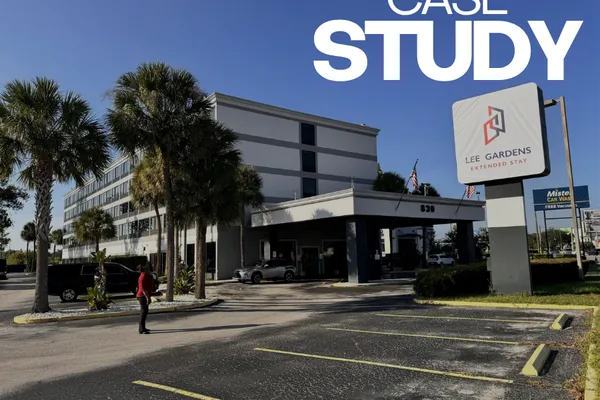
How Avaneo Hotels Turned Una into a Digital Front Office Employee

Hotel automation is easy when the question is simple.
What time is check-in? Is parking free? How much does breakfast cost?
The real test begins when a guest wants to book several rooms, asks for a corporate rate, changes the conditions halfway through the conversation, needs a booking link sent to their phone, calls outside normal reception hours, or simply insists on speaking with a person.
That is the environment in which Avaneo Hotels introduced Una by Polydom.
The implementation began in June 2026 with a clear objective: Una should not become another chatbot sitting on the hotel website. She needed to operate as part of the Front Office, handling real guest demand across channels while working within Avaneo's existing operational rules and technology stack.
Within the first weeks of operation, the difference became visible not only to the hotel team, but also to its guests.
One of Avaneo's corporate clients liked Una's booking widget and the booking experience so much that the company decided to use the widget for its future reservations.
For Avaneo, that was an important signal. Automation was no longer simply reducing repetitive work behind the scenes. It was becoming a booking experience that guests actively preferred to use.
The Challenge: A Digital Hotel Still Has a Very Human Workload
Avaneo Hotel Marktredwitz already operates with a highly digital guest journey. The challenge was therefore not to replace an outdated operation with technology.
The challenge was to connect the work that still happens between systems, channels and people.
A guest may start with a phone call asking about availability. Another may arrive through the website and compare several room categories. A corporate booker may need multiple rooms under different guest names. Someone else may ask about breakfast, parking, an electric vehicle charging point, cancellation conditions and payment before deciding whether to book.
Then there are existing guests who need help with check-in, booking changes, invoices or access outside normal Front Office hours.
Each individual question may look simple. Together, they create a continuous operational workload.
Avaneo needed an AI receptionist that could understand these conversations, access the relevant hotel information, work with live booking conditions and know when the correct outcome was not another answer but a booking link, an escalation or a transfer to a human colleague.
Building Una Around the Hotel's Real Operating Rules
The implementation was not based on a generic hospitality script.
Una was configured around the way Avaneo actually operates.
The hotel's knowledge sources were consolidated and checked before launch. German and English became the primary guest languages while Una remained capable of understanding additional languages. Incoming email logic was separated so guest enquiries could be handled appropriately while automated system notifications would not create unnecessary responses.
The booking flow was connected with Avaneo's Apaleo environment, including the hotel's corporate-rate logic.
That last point was particularly important because corporate business represents a significant part of Avaneo's reservation workflow. Instead of treating every caller as a leisure guest and pushing everyone toward a public booking engine, Una was taught to recognize the corporate booking path, confirm the relevant company context and apply the appropriate booking logic.
Payment and guarantee rules were also aligned with the rate being sold. Depending on the rate conditions, the workflow can distinguish between bookings that require a card guarantee, prepayment and corporate arrangements where a card may not be required.
The result is not simply a more knowledgeable chatbot. It is an AI front desk employee operating according to the commercial and operational rules of the hotel.
A Booking Conversation Can Now Continue All the Way to Action
The clearest examples come from actual guest conversations.
In one website conversation, a guest wanted five single rooms for four nights. Una checked availability and presented several Premium and Deluxe options with both non-refundable and flexible rates.
The guest then added breakfast.
Instead of starting the search again or asking the guest to contact reception, Una calculated the breakfast supplement for five people across four nights and presented updated totals for each available option.
That distinction matters.
The guest did not receive an answer telling them that breakfast was available. They received the information required to continue making a purchasing decision.
The same pattern appears repeatedly across the booking journey. Guests ask about room differences, breakfast, parking, cancellation conditions or payment options, and Una keeps the context of the conversation while moving them toward the appropriate next step.
From "Do You Have a Room?" to a Direct Booking Link
Phone reservations show the operational difference even more clearly.
A caller can ask for a room, provide arrival and departure dates, specify the number of guests and choose between available room categories and rate conditions.
Once the guest has selected an option, Una can prepare the appropriate booking path and send the booking link through supported channels such as SMS or WhatsApp.
In one real interaction, a guest called in the evening looking for a Premium Double Room for two people. Una checked the available rates, explained the difference, confirmed the guest's selection and sent the booking link by SMS and WhatsApp during the same conversation.
In another call, a guest was simply looking for the cheapest available room. Una identified the lowest-priced option and sent the corresponding booking link. When the caller did not immediately understand what had been sent, Una explained where to find it and what to do next.
These are small moments, but they illustrate an important difference between conversational AI and operational AI.
A chatbot can tell someone that rooms are available.
A hotel AI booking assistant can help turn that availability into a bookable next step.
Multi-Room Reservations Without Losing the Context
Hotel booking conversations rarely stay perfectly structured.
A guest may initially ask for one room and then clarify that they need two. They may want separate rooms for separate travellers, breakfast for everyone, parking and a flexible cancellation policy.
Una has handled exactly this kind of conversation at Avaneo.
In one real website interaction, the guest asked for two rooms for two individual travellers. The conversation expanded to include breakfast, parking, flexible cancellation and questions about paying on arrival.
Una maintained the booking context, recalculated the relevant totals and prepared the appropriate multi-room booking flow.
Avaneo and Polydom also developed the implementation so that multi-room bookings could collect individual guest details for each room rather than placing every room under one name. For larger or unsupported requests, the workflow can escalate rather than forcing the guest through an unsuitable automated path.
This is particularly important for corporate travel, where a "room booking" can quickly become a small operational workflow of its own.
Corporate Reservations Required Different Rules
One of the most important lessons from the Avaneo implementation was that hotel automation cannot treat every reservation request identically.
Corporate travellers often have fixed dates. If the requested inventory is unavailable, suggesting a different weekend may be perfectly reasonable for a leisure guest but useless for someone travelling for work.
Avaneo identified this distinction during live operation.
The workflow was subsequently adjusted so that corporate enquiries without suitable availability can be passed to the Front Office instead of automatically steering the guest toward alternatives that do not solve the actual problem.
This is an example of the way Una has evolved at Avaneo: guest conversations reveal operational edge cases, the hotel provides feedback, and the workflow is refined around what the team actually needs.
The Front Office Does Not Need Every Call
Some of the strongest evidence of Una's value comes from the calls that do not require a member of staff.
Guests repeatedly call hotels to ask about check-in and check-out times, reception opening hours, parking, breakfast, room categories, pets, payment conditions, public transport, late check-out and other routine information.
At Avaneo, Una can handle these conversations directly.
A guest asking how to check in can be guided through the hotel's self-service process. Someone arriving after normal Front Office hours can receive the relevant instructions. A caller asking about room availability can receive live options. A guest asking about parking or breakfast can continue the same conversation without being transferred from one person to another.
That means the Front Office does not have to interrupt higher-value work every time the phone rings.
As Avaneo's Director Alexander Herold described the experience:
"For our Front Office, Una is an enormous relief."
He explained that Una answers and filters incoming calls, handles relevant requests efficiently and allows the team to concentrate on cases where human involvement genuinely adds value.
That is a more useful definition of hotel AI automation than simply counting how many questions an AI can answer.
The objective is not to eliminate human service. It is to stop using human attention where it is not necessary.
And When a Human Is Needed, Una Knows That Too
A useful AI receptionist must also know its boundaries.
At Avaneo, some situations are intentionally escalated.
When a caller explicitly asks for the Front Office or hotel management, Una can transfer the call according to the configured workflow. When a reservation modification requires staff action, the request can be collected and passed to the hotel team. Invoice questions and other workflows that are not yet fully automated can similarly be routed rather than answered with invented information.
The same principle applies to operational uncertainty.
For example, Una can guide an after-hours guest through the approved access process, but certain key-card or kiosk conditions cannot be verified through Apaleo. In those situations, the workflow is designed to escalate rather than guess.
This combination of automation and guardrails is essential in hospitality.
The goal is not maximum automation at any cost. The goal is maximum useful automation while preserving a clear path to human judgment.
Una Can Handle the Messiness of Real Conversations
Real guests do not speak like booking forms.
They change their minds. They mispronounce dates. They correct the number of rooms halfway through a call. They switch languages. They ask three unrelated questions before returning to the original booking.
One Avaneo caller began by asking for two rooms, then explained that five family members needed to be distributed across them. After learning that the requested occupancy would require a different arrangement, the guest asked to speak with hotel staff instead.
Another caller moved between German and English while asking for a room and later requested human assistance.
In another interaction, a caller repeatedly asked for "Rezeption" until Una confirmed that they wanted the reception team and transferred the call.
These conversations are valuable examples precisely because they are not polished demo scenarios.
Hospitality automation has to work with the way people actually communicate.
A Corporate Guest Gave Avaneo One of the Strongest Possible Signals
Operational efficiency is important, but the guest experience remains the harder test.
Avaneo received direct feedback from one of its corporate clients after the company used Una's booking widget.
The client liked both the widget and the overall booking experience enough to decide that future reservations would be made exclusively through that channel.
For Avaneo, this provided evidence that the system was not merely functioning technically. The experience was good enough for a real customer to change its booking behaviour voluntarily.
That is particularly significant for direct booking.
Hotels do not increase direct reservations simply by adding another "Book Now" button. The booking journey has to make it easy for the guest to understand availability, rates, room differences and conditions and then move directly into a transaction.
Una places that booking journey inside the conversation.
The Product Also Changed Because Avaneo Used It
The Avaneo implementation is also a case study in how operational AI should be deployed.
Not every workflow was perfect on day one.
During the rollout, Avaneo identified edge cases involving corporate reservations, multi-room searches, telephone routing, caller identification, booking extras, payment logic and email handling.
Those issues became implementation work rather than permanent limitations.
For example, feedback around multi-room reservations led to improvements in how different rate plans and cancellation policies were handled. Corporate booking behaviour was refined based on the reality that business travellers often cannot simply change dates. Booking extras such as breakfast were incorporated into the booking flow. Telephone routing was adjusted so that calls requiring human involvement could reach the appropriate Front Office path.
Avaneo specifically highlighted this speed of iteration in its feedback, noting that ideas were understood, evaluated and translated into practical solutions without lengthy delays.
For a hotel introducing an AI employee into live operations, that matters.
The real implementation begins when actual guests stop behaving like test cases.
One Guest Journey, Multiple Systems
The Avaneo case also illustrates why hotel AI increasingly needs to operate beyond a single communication channel.
A guest may discover the hotel online, ask a question through the website, call later, receive a booking link through SMS or WhatsApp and complete the reservation through the hotel's booking infrastructure.
From the guest's perspective, this should feel like one journey.
From the hotel's perspective, several systems may be involved.
Una acts as the conversational and operational layer between those moments. She can understand the request, retrieve the information required for the next decision, provide the appropriate booking path and escalate when the workflow reaches a point where a human should take over.
That is why describing Una simply as an AI chatbot misses the larger operational role.
Chatbots answer.
An AI front desk employee has to help the work move forward.
What Avaneo Has Automated with Una
The implementation now covers a broad range of guest-facing and Front Office workflows, including direct room availability enquiries, live rate comparison, corporate booking assistance, multi-room booking, booking links, payment and guarantee logic, breakfast and other booking extras, common pre-arrival questions, check-in and check-out guidance, after-hours access instructions, email handling, inbound phone calls and human escalation.
More importantly, these capabilities are not isolated features.
They operate inside actual guest journeys.
A guest can start with "Do you have a room?" and end with the correct booking path without requiring a Front Office employee to manually reconstruct the conversation between systems.
The Result: Human Attention Goes Where It Matters
Avaneo does not describe Una as a replacement for hospitality.
The opposite is closer to what happened.
By taking responsibility for repetitive calls, booking enquiries and predictable guest questions, Una gives the Front Office more room to deal with situations where experience, judgment and personal attention matter.
As Alexander Herold explained:
"Our team can therefore focus its time and attention on the cases where human involvement genuinely adds value."
That may be the most important result of the implementation.
The value of an AI receptionist is not measured by how convincingly it imitates a human employee.
It is measured by how much routine work it can reliably carry forward without creating more work somewhere else.
What Avaneo's Experience Shows Other Hotels
The Avaneo implementation demonstrates a practical path for hotels considering AI automation.
Start with real operations rather than a generic list of AI features.
Connect the AI to the systems and policies that determine what the hotel can actually offer. Give it enough context to distinguish a corporate reservation from a leisure enquiry. Allow routine workflows to proceed automatically, but define clear guardrails around situations that require human judgment.
Then use real guest interactions to improve the system.
Avaneo's experience also shows why the most valuable hotel AI may not be the AI that produces the best answer.
It may be the one that knows what needs to happen after the answer.
For one guest, that means receiving a direct booking link.
For another, it means comparing several room and rate combinations.
For a corporate traveller, it means following the correct contracted booking path.
For someone who needs a person, it means reaching the Front Office rather than fighting with an automated system.
And for the hotel team, it means fewer repetitive interruptions and more time for the work where people make the greatest difference.
From AI Receptionist to Digital Employee
After several weeks of live operation, Avaneo described its overall experience with Una as entirely positive and highlighted both the breadth of workflows already covered and the speed with which feedback had been converted into improvements.
There are still workflows to refine and additional processes that can be automated. That is expected.
What matters is that Una has already moved beyond answering hotel FAQs.
She handles calls. She supports direct and corporate booking journeys. She works with live availability and rates. She guides guests through operational questions. She sends them toward the next action. She filters what the Front Office needs to see and escalates situations where human judgment is genuinely required.
That is the difference between putting AI on a hotel website and putting AI to work inside hotel operations.
Chatbots answer questions. Una helps handle the guest.