10,096 Hours of Live Operations: What Zeevou + Una Actually Delivered
Today’s hospitality operators need technology that can understand what is happening in the operation, respond to guests in context, complete routine actions when the rules are clear, and bring a human team member in when judgment is required.
That is exactly what you get when connecting Una by Polydom — a pre-trained, AI-native digital employee — directly to your Zeevou PMS.
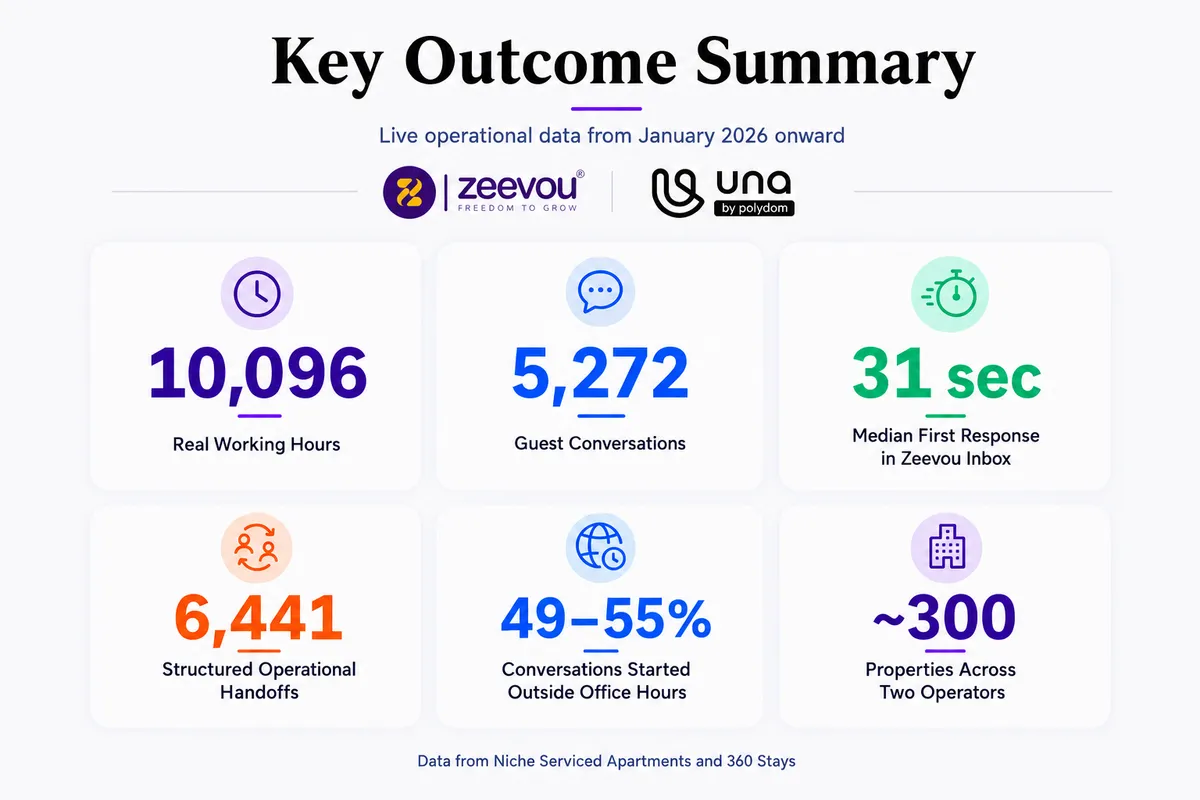
To understand what this looks like in practice, we analyzed live operational data collected from January 2026 onward across Niche Serviced Apartments, UK and 360 Stays, UK - two serviced-apartment operators managing around 300 properties in total.
The analysis covered Una’s 10,096 real working hours and 5,272 real guest conversations, thousands of reservations, and the operational actions created from those conversations.
The result shows a different model for hospitality automation: Zeevou remains the operational system of record, while Una becomes the first digital line between the guest, the reservation, and the human team.
From Guest Message to Operational Action
What happens after a guest asks whether they can stay another two nights. A chatbot can recognize the request and tell the team about it.
With Zeevou connected, Una can go further.
Una can identify the reservation, check the relevant context and availability, quote the extension and, where the operator has authorized the workflow, create the extension directly in Zeevou.
Across the two live operations analyzed, Una created 90 confirmed stay extensions directly in Zeevou.
These were not notes for someone to process later. They became reservations inside the same PMS the teams already use.
This distinction matters operationally.
The guest does not have to repeat the request to another person. The employee does not need to reopen the conversation, identify the reservation, recheck the dates, and manually transfer the information into the PMS.
The conversation initiates a workflow that Una can carry out within the operator’s authorized rules.
Direct Booking Opportunities Do Not Have to Wait
The same principle applies before a reservation is made.
Someone may be researching a stay at 4 p.m., 9 p.m., or on Sunday. If the guest is ready to move forward, every additional handoff creates friction.
In one documented live workflow, a guest began an inquiry through the operator's website. Una checked the live information, provided the relevant option, and sent the direct booking payment link.
Five minutes and 57 seconds later, the completed Direct-Web reservation appeared in Zeevou — without the team touching the chain.
The point is not the value of one reservation.
The value is the workflow:
guest intent → live PMS context → conversation → direct booking path → reservation recorded in Zeevou
AI is no longer just answering a sales question. It can help keep the booking journey moving while the guest still has active intent.
And when a human needs to complete the sale, Una can still collect the requirements, identify the right context, and pass a qualified conversation to the team rather than handing over a cold enquiry.
A First Line That Works When the Office Does Not
Guest demand rarely follows office hours.
Across the two operators, when evenings and weekends are included, approximately 49% to 55% of guest conversations began outside standard working hours.
That means roughly half of the communication load can appear at a time when maintaining equivalent human coverage is difficult and expensive.
Una provides that first line continuously.
Over the full analyzed periods, she was first to respond to around nine out of ten guest messages. During the most recent 60-day period, that figure rose to approximately 94% at both operations.
The median first response time inside the Zeevou inbox was approximately 31 seconds.
For the guest, that means a problem does not sit unanswered simply because it arrived late in the evening.
For the operator, it means the morning shift does not have to begin by working through a backlog of conversations that accumulated overnight.
And response speed matters most when something has already gone wrong: an access issue, a change in arrival time, a maintenance problem, or a guest who simply does not know what to do next.
Working Where Guests Actually Communicate
A website chatbot only meets the people who visit the operator's website.
That represents only one part of the hospitality guest journey.
A large share of guest communication is already happening inside OTA conversations — before arrival, during the stay, and when plans change.
Because Una works through the Zeevou guest messaging environment, she can operate inside that existing communication flow rather than creating a parallel inbox.
Across both operators, Una was present in conversations covering more than half of their OTA guest flow.
In the Niche account, her presence was particularly high in Airbnb communication, reaching more than 70% of Airbnb reservations during the analyzed period.
This is important because the operational value of AI depends on where it is available.
If AI only handles website enquiries, the team still needs to manage most in-stay and OTA communication manually.
Connecting Una to Zeevou moves AI from the edge of the operation into the guest journey itself.
The Human Team Receives a Task, Not a Raw Conversation
Hospitality contains too many situations that require discretion: complaints, safety issues, compensation, unusual requests, exceptions to policy, or circumstances where a human relationship matters.
The stronger operating model is therefore not AI instead of people.
It is AI deciding when people need to become involved — and preparing the situation before they do.
Across Niche Serviced Apartments and 360 Stays, Una created 6,441 structured operational records for the teams.
The largest categories included access and keys, maintenance, parking, housekeeping, changes to arrival or departure times, and stay extensions.
Instead of receiving an unstructured message saying, “Guest needs help,” the team can receive the guest name, property, reservation reference, and a summary of what is happening.
The employee enters the conversation with context already assembled.
That shifts the role of the human team from dispatcher and information collector toward decision-maker and exception handler.
Multilingual Service Becomes Part of the Same Workflow
International operators face another problem: guest communication may arrive in many different languages, but the underlying operating rules remain the same.
During the analyzed periods, Una communicated in 16 languages beyond English in one operation and 15 in the other.
The important part is not translation alone.
The guest can communicate in their preferred language while Una still works from the same property information, reservation context, operational rules, and escalation logic connected to the business.
That creates a much more scalable model than trying to match every guest language with every human shift.
The Operator Still Controls the Boundary
PMS-connected automation only works if the operator remains in control.
With Zeevou + Una, that boundary can be defined workflow by workflow.
For a standard action with clear rules, Una can be authorized to complete it.
For another process, she may gather all required information and create a structured task.
For a sensitive situation, she can involve a human immediately.
And that boundary can change.
If an operator temporarily pauses one automated action, Una can continue answering guests, identifying reservations, and collecting the context required by the team.
The first line does not need to disappear simply because one workflow is moved back to human approval.
This makes automation something operators can expand progressively rather than an all-or-nothing decision.
For a real operator perspective, watch Martyn Cooper of Niche Serviced Apartments discuss Zeevou + Una in live operations.
Why the Zeevou Integration Matters
The most important result of the integration is not that guests receive AI-generated responses.
It is that guest conversations become connected to the operating system where the business is actually managed.
Zeevou remains the source of truth for the reservation and the operational record.
Una adds the active layer around it.
She can respond when the team is unavailable, understand reservation context, work inside existing guest communication, execute repeatable workflows, support direct booking opportunities, create structured operational handoffs, and escalate the moments that require human judgment.
The result is not a second inbox or another disconnected workflow.
It is a hybrid operating model:
Zeevou holds the operational context. Una turns that context into 24/7 action. The human team retains control and handles the moments where human judgment adds the most value.
That is where PMS-integrated AI begins to move beyond messaging automation and become part of daily hospitality operations.
Want to Know What Una Could Do in Your Operation?
If you have questions about how Una could work with your business, you do not have to wait for a sales call to find out.
Speak with Una directly.
Visit Polydom.ai and click “Interview me.”
Tell Una about your properties, your current workflows, and the operational challenges you want to solve and she will answer and share relevant real-world examples.
Una speaks your language and is available 24/7 — just like the role she is designed to perform.