Who Owns the Guest Relationship in the Era of OTA Restrictions?

Who Owns the Guest Relationship in the Era of OTA Restrictions?
As OTA rules shape guest communication, professional short-term rental managers have an opportunity to preserve their local advantage—with optional digital concierge services, conversational AI, and responsible service delivery.
Short-Term Rentals Should Not Lose Their Local Soul
A family arrives at a vacation rental in a coastal town. The house is beautiful, check-in is easy, and everything works as expected. The next morning, the guests want something more: a local guide, a small restaurant that residents love, or a boat trip operated by a family-owned business. But who do they ask?
There is no hotel reception desk. The property manager may be coordinating dozens or hundreds of homes across the destination. The guests open a search engine and begin planning independently. At that moment, the operator loses an opportunity to be part of the experience beyond the accommodation.
Short-term rentals offer something distinctive: a connection to neighborhoods, independent businesses, unique homes, and the people who make each destination different. Technology should strengthen that connection, not replace it. The challenge is to make local hospitality accessible at scale, while respecting the rules of the online travel agencies (OTAs) that bring guests to the property.
OTA Rules: Protect the Booking Without Abandoning the Guest
OTA platforms have legitimate reasons to keep reservations, payments, and sensitive guest information within protected systems. But a guest’s needs do not stop when a reservation is confirmed. During a stay, guests may ask about transportation, restaurants, equipment rentals, tours, or other optional services that are not part of their accommodation booking.
The distinction between the accommodation transaction and a separate, genuinely optional guest service is important. It is not a blanket permission to redirect conversations or payments away from an OTA.
What Airbnb’s updated rules say
Airbnb’s policy on host-imposed contracts and other requirements, applicable to reservations booked on or after November 20, 2026, specifically allows hosts to offer optional applications that facilitate a guest’s experience during a stay, including concierge apps. It also allows optional recommendations of local experiences, restaurants, and businesses when any direct financial benefit to the host is disclosed.
Those permissions have limits. Airbnb restricts requests for guests’ personal information outside stated exceptions, prohibits requiring certain third-party registrations, and requires accommodation bookings, paid extensions, and mandatory charges to remain within its prescribed payment processes, subject to specific exceptions. Its policy also prohibits asking guests to move pre-booking communication outside the platform.
The practical lesson: a QR-based concierge may be an appropriate additional service channel, but it must be configured for the specific OTA’s rules. It should not be used to move protected reservation transactions, collect unnecessary contact details, or pressure guests into off-platform activity.
Other OTAs have their own agreements, messaging procedures, and data-use requirements. Operators should evaluate each channel rather than assume that one set of rules applies to all bookings.
The Missing Front Desk in Short-Term Rentals
In a hotel, guests generally know whom to approach. They can call reception or speak to a concierge. In a professionally managed vacation rental, they may never meet an employee. The management team can be miles away, supporting properties across an entire city or region.
That efficient operating model creates a service gap. A guest may want a late-night transfer, a recommendation suitable for children, or help arranging an unexpected service. The local team may know exactly whom to call, but its knowledge is not always available the moment the guest asks.
A digital point of contact can make reliable support more consistent without making every property feel the same. We should standardize service quality—not the local guest experience itself.
A QR Code Is the Entry Point, Not the Service
A QR code by itself is simply a link. It might open a static welcome book with Wi-Fi details and a list of attractions. That is useful, but it still leaves guests to navigate categories, compare options, and contact service providers themselves.
Placed in a home, a QR code can instead open an optional, browser-based conversation with a digital concierge. Guests can describe what they need in natural language rather than search through menus. With Una by Polydom, the conversation can happen through text or voice. Una can use configured property knowledge, explain available options, help structure requests, and carry out supported workflows or escalate to staff when human judgment is required.
This does not eliminate the OTA inbox. Booking-related communication should remain where platform policy requires it. The QR-based service adds a convenient, optional way to discover assistance and local experiences while on the property.
Polydom and Explorabout: From Filters to Conversation
Our conversations with Explorabout, Polydom’s local-experiences partner, have reinforced a basic problem in digital concierge design: even a carefully curated catalogue can be difficult for a guest to navigate. A traditional interface often asks travelers to choose a category, set filters, compare packages, and decide whether a particular experience fits their needs.
Consider a guest asking: “We’re here for five days with two children. We want something outdoors, not too crowded, and we only have tomorrow afternoon. What would you recommend?”
A conventional chatbot limited to scripted answers may return generic links. A conversational AI Digital Employee can instead clarify preferences through text or voice and help match the request to relevant information and available packages. When the appropriate integration is in place, this can extend into package selection and the coordination of a service request. Exact booking, availability, payment, and confirmation steps depend on the integration and the provider’s operational setup.
The important improvement is that guests do not need to learn the structure of a catalogue. They can describe the experience they want, ask follow-up questions, and refine the options in a conversation. AI does not make local expertise unnecessary; it makes that expertise easier to access.
For STR operators, this can create a stronger relationship with guests. For small local businesses, better discovery can help them reach visitors who might otherwise book through generic search results—or never discover the experience at all. This is the practical intersection between local hospitality and the Polydom–Explorabout partnership.
Dubai: An Optional Service That Starts With a QR Code
A Polydom client in Dubai uses QR-code access to support guest requests for airport transfers. The example illustrates why a digital concierge can matter when there is no physical front desk. A transfer request may involve pickup timing, passenger count, luggage, destination, and coordination with a transport provider. It is more complex than displaying a telephone number.
The precise workflow depends on the operator’s agreements and configured tools. A digital employee can help gather relevant service requirements and support coordination, while staff or authorized providers handle tasks that require their participation. This article does not assume that every request is booked, paid for, or completed autonomously.
The larger point is that the manager can continue providing hospitality after check-in rather than leaving guests to arrange every optional service alone. This can support a better experience and creates a potential ancillary revenue opportunity, where an appropriate commercial arrangement exists.
What Guest Behavior Can Tell Us About Ancillary Services
Anonymized operational data can help answer two important questions: Does demand for optional services vary with the length of the stay? And when, relative to arrival and departure, do guests make these requests?
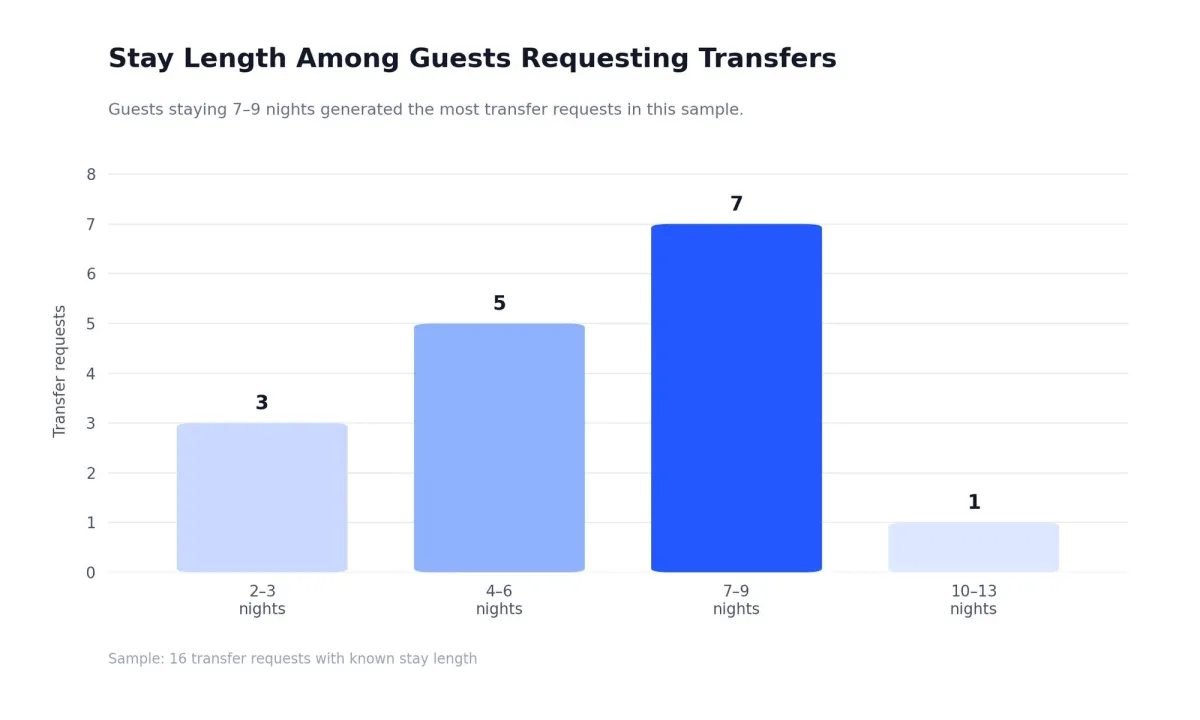
Comparing request rates—not only the total number of requests—matters because longer stays naturally provide more opportunities to ask for assistance. Any finding that longer-stay guests request more services should be reported as observed behavior in this sample, not as proof that they are inherently more affluent or more willing to pay.
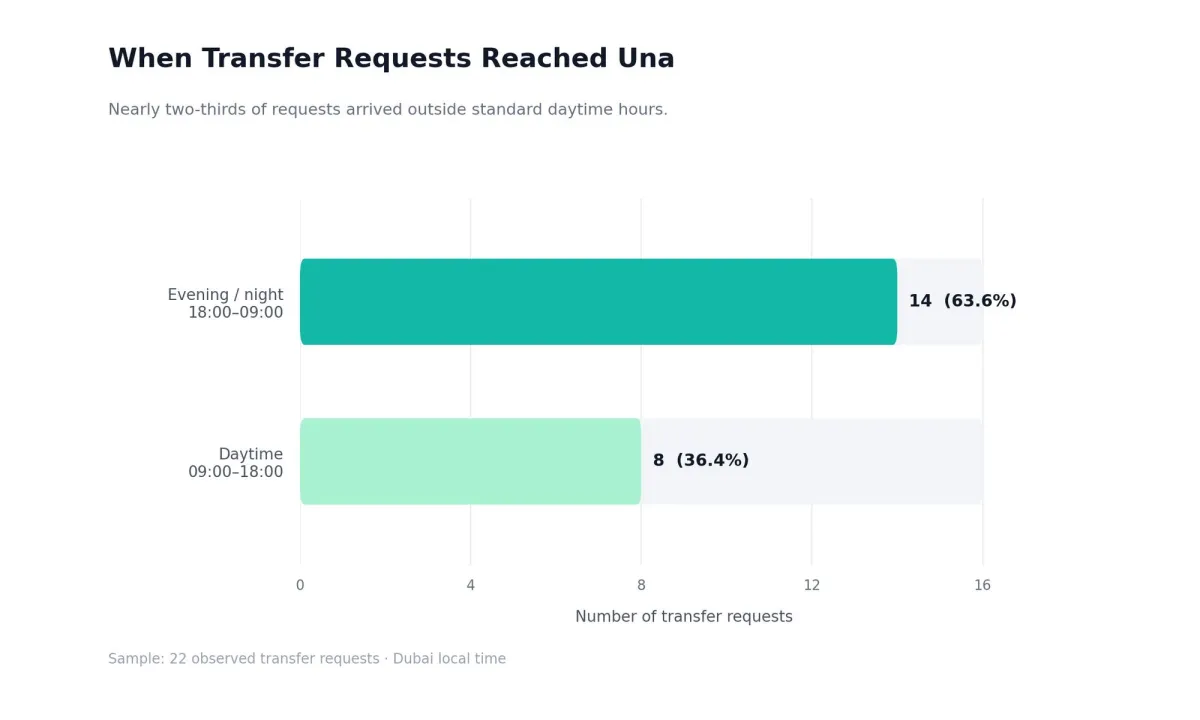
These two views can reveal where an accessible digital concierge is most useful: before arrival, during daily activities, or when departure logistics become urgent. They also help operators decide when to display relevant services and when to prioritize staff or supplier availability.
The Dubai findings should be presented as an anonymized two-month operational snapshot only if the underlying MCP export confirms that duration. No property identity, exact calendar dates, or unsupported spending claims are needed to explain the operational pattern.
Keeping the Operator in the Service Relationship
A request for a chef, a local experience, or airport transportation does not always need to end with the guest being handed a list of external contacts. There are several legitimate service models. The property manager may recommend an independent provider, act as a coordinator for approved local partners, or deliver certain services directly through its own business.
Each model has different responsibilities. The guest should know who supplies the service, what information is shared, and how payment and confirmation work. A genuine concierge or direct-service relationship does not override OTA restrictions, local licensing requirements, or applicable data-protection rules.
The strongest opportunity is not to find a technical workaround to an OTA policy. It is to create a real, transparent service that adds value to the guest and respects the booking channel.
Protecting Local Businesses—and the Character of STR
Short-term rentals are embedded in communities. Local restaurants, independent drivers, guides, private chefs, and small tour operators can all contribute to the destination experience. Property managers who understand those networks can help guests discover services that are more personal than a generic search result.
This is also an economic opportunity for local communities. Making trustworthy local partners discoverable can direct more visitor interest to smaller businesses. Outcomes will vary by destination and provider, but the principle is straightforward: hospitality businesses are more valuable to their communities when they help connect visitors with local people and services.
Professional operators need consistency across portfolios, but consistency does not require uniformity. A digital employee can follow common operating rules while drawing on property-specific knowledge, local recommendations, and different partner networks in each destination.
That is the distinction worth preserving: standardize the quality of support, not the individuality of the destination.
A Responsible Operating Model for QR-Based Concierge Services
Before introducing a digital concierge, managers should define which requests belong in the OTA booking channel, which services are genuinely optional, who provides each service, and what information is necessary to fulfill it. They should also disclose financial relationships where required, provide a path to human assistance, and ensure that a request is not described as a confirmed order until the supplier or system has actually confirmed it.
The implementation should be simple for the guest: scan, ask, refine, and receive a clear next step. Behind that simplicity are permissions, integrations, policies, supplier relationships, and staff escalation rules. A digital employee is valuable when it helps coordinate those elements—not when it merely produces another polished answer.
The Hybrid Hospitality Opportunity
AI in hospitality is often evaluated only in terms of messages answered or staff hours saved. Those measurements matter, but the deeper question is what the team can now provide. Can guests receive useful service outside office hours? Can managers support more properties without losing local knowledge? Can employees spend less time navigating systems and more time nurturing relationships with guests and trusted local partners?
Una by Polydom is positioned as an AI Digital Employee because the goal is not simply a better chatbot. It is a digital worker that can communicate, follow configured rules, coordinate supported processes, and involve people when needed. Human teams remain responsible for judgment, relationships, exceptions, and the local hospitality that gives a stay its character.
The future of STR should not be a choice between a standardized automated experience and a personal local one. The industry can aim for both: reliable, responsive operations and authentic connections to the places guests came to discover.
The Guest Relationship Should Continue Beyond Booking
OTAs help travelers find and reserve places to stay. Property managers shape what happens after the booking. That difference matters most in short-term rentals, where the accommodation itself is only one part of the destination experience.
A QR code may look like a small detail inside a vacation home. Combined with a capable digital employee and genuine local-service relationships, it can make hospitality easier to reach, help guests discover what is unique about a place, and connect local businesses with more relevant opportunities.
The objective is not to move bookings away from OTAs or replace human hospitality. It is to preserve the STR industry’s local soul while bringing consistency, accessibility, and better coordination to the guest experience.
Digital to Digital. Human to the Guest.
Explore a Digital Concierge for Your STR Portfolio
Una by Polydom helps professional STR managers provide conversational guest assistance, coordinate supported operational workflows, and connect guests with relevant information and services. Learn more about Una for Short-Term Rentals.