When a Guest's AI Agent Wants to Book, Who Answers for the Hotel?

The B2A economy is changing how customers find and buy services. For hotels pursuing direct bookings, the next opportunity may be having their own digital employees ready to handle requests from AI agents.
Imagine a traveler asking their AI assistant:
"Find me a hotel for three nights near the city center, with parking and flexible cancellation. Compare the options and book the best one."
The AI agent searches, compares hotels, evaluates the offers, and identifies a property that meets the traveler's needs.
Now comes the important question.
If the guest's AI agent can search, compare, and request a reservation, who will handle that request on the hotel's side?
For independent hotels trying to grow direct bookings rather than depend entirely on online travel agencies (OTAs), this question may become increasingly important.
A hotel could be perfectly visible to AI search systems and still lack the ability to complete the transaction directly.
The opportunity is no longer just to be discovered. It is to be ready to do business.
Welcome to the B2A Economy
In their November 11, 2026 article, Welcome to the B2A Economy, Olivia Moore and Justine Moore of Andreessen Horowitz (a16z) describe an important shift in how businesses may interact with customers.
AI agents are evolving from tools that answer questions into systems capable of evaluating options and completing tasks on behalf of their users.
The authors make a particularly relevant observation:
"GEO largely stops at discovery."
They argue that AI agents can take the next step into evaluating and executing purchasing decisions.
For hospitality, this distinction matters.
Being recommended by an AI assistant is one thing. Being able to accept and complete the resulting booking is another.
B2A — Business-to-Agent — describes an emerging commercial environment in which businesses increasingly serve software agents acting on behalf of customers.
And that brings us to an additional concept: Agent-to-Agent (A2A) interaction.
What happens when the guest has an AI agent representing their interests, and the hotel has a digital employee representing its own business?
Instead of requiring a human to manually carry every step forward, the two systems could exchange information and, when properly authorized, execute a reservation.
This is not yet a universal booking model across hospitality. But it raises a practical question about the infrastructure and operating capacity hotels will need.
Direct Booking in the Age of AI Agents
For years, hotels have invested in their websites, booking engines, direct marketing, loyalty programs, and search visibility to encourage guests to book directly.
At the same time, OTAs have played an important role in helping properties reach travelers they might not otherwise attract.
AI agents could introduce another layer into that relationship.
A guest may increasingly rely on an AI assistant to compare not only room prices, but also cancellation conditions, parking, breakfast, check-in flexibility, or other details that influence a booking decision.
The agent might complete the booking through an OTA, another distribution intermediary, or a hotel's own direct channel.
AI-driven discovery does not automatically mean direct booking.
For an independent hotel, the opportunity is to make its direct channel capable of participating in this new booking process.
Consider a guest's AI agent requesting a room with parking and late check-out.
The hotel's response may require more than simply displaying a room rate.
Can the hotel confirm availability for the correct dates? Can it provide the applicable rate and conditions? Can it determine whether late check-out is available and what it costs? Can it process the reservation through its own systems?
If the agent receives incomplete information or cannot complete the transaction, it may use another supported booking route.
This creates a new dimension of direct booking competitiveness.
Hotels need to be ready not only to attract booking demand, but to execute it.
And execution requires more than an AI-friendly website.
Agent-to-Agent: Who Works on the Hotel's Side?
In the traditional booking process, the interaction is generally between a guest and a hotel employee, a booking engine, or an OTA platform.
In an emerging Agent-to-Agent model, a different interaction becomes possible.
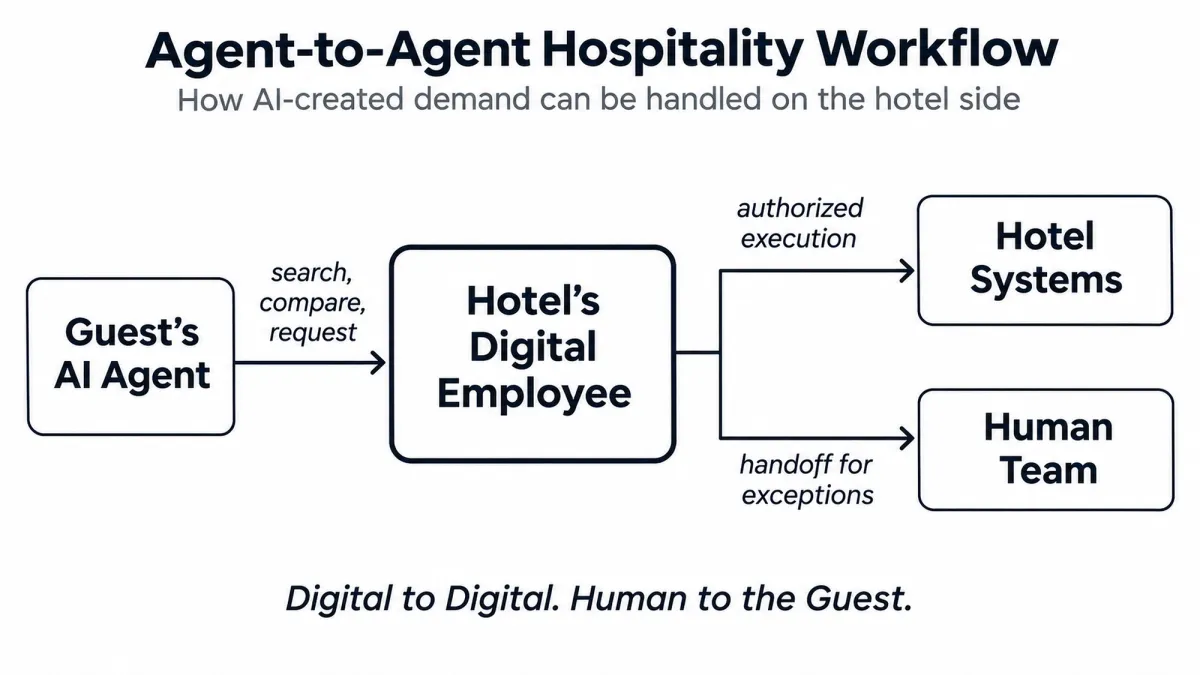
The guest's AI agent represents the traveler.
The hotel's digital employee represents the hospitality operator.
Each has a different responsibility.
The guest's agent seeks the best available option within the traveler's preferences, budget, and permissions.
The hotel's digital employee operates according to the property's inventory, rates, booking policies, business rules, and authorized workflows.
This is where we see the next evolution of hotel operations.
The operating model can be described in four steps:
- AI agents create demand. Travelers delegate more search, comparison, and potentially booking activities to their digital assistants.
- Hotels need execution capacity. The property must be able to receive requests, provide accurate information, and move a booking forward through its direct channel.
- Digital employees perform authorized work. An AI Digital Employee connected to hotel systems can carry out supported reservation tasks according to the operator's rules and permissions.
- Humans retain hospitality and control. Hotel employees remain responsible for exceptional decisions, personal service, guest relationships, and situations requiring human judgment.
The most important change is not simply that AI systems can communicate with each other.
It is that communication can lead to real business execution.
A guest's agent might request a reservation. The hotel's digital employee could verify availability, apply the relevant booking conditions, initiate a permitted reservation action, and provide confirmation through an authorized workflow.
Where additional approval is required, the request would be handed to a human employee.
The transaction becomes part of the hotel's existing operation rather than a separate conversation that someone must manually complete later.
The Digital Employee: From Conversation to Execution
At Polydom, we have been developing this operational model through Una, our AI Digital Employee for hospitality.
Una works within existing hotel systems to handle guest communication and carry out supported operational tasks, including reservations.
Today, Una interacts with guests through channels such as phone calls, website conversations, and messaging services. Depending on the property's integrations and permissions, she can retrieve booking information, support reservations, and execute authorized actions.
This distinction matters.
A chatbot can tell a guest where to make a booking.
A digital employee with the necessary system access and permissions can participate in completing the booking itself.
And this is already producing measurable results in hotel operations.
At Lee Gardens Extended Stay in Orlando, Una completed 232 direct reservations, representing $80,968 in reported booking revenue over a ten-month period.
During the same period, she handled 4,104 guest conversations, with only 80 requiring human involvement.
These results come from a real hotel deployment, not a projected industry average. The reported booking revenue should not be interpreted as entirely incremental.
They demonstrate something important: an AI Digital Employee can already move beyond answering questions and participate in completing real reservations.
These were not autonomous bookings negotiated between an external guest agent and Una. They were direct booking workflows carried out through existing communication channels and connected hotel systems.
However, they establish an operational foundation relevant to future Agent-to-Agent interactions.
The hotel already has a digital employee capable of performing certain authorized booking tasks.
The next challenge is enabling external agents to interact with that capability securely and reliably.
The Missing Piece: Authorized Agent Access
For Agent-to-Agent booking to work at scale, hotels need more than two AI systems capable of exchanging messages.
They need a trusted way to execute transactions.
An external AI agent must be able to demonstrate whom it represents and what it is authorized to do.
The hotel must retain control over rates, availability, reservation conditions, payment requirements, and the actions permitted within its systems.
Every completed action needs to be traceable, and sensitive or exceptional decisions must remain subject to appropriate controls.
Technologies such as APIs, MCP-based integrations, and emerging agent protocols can provide parts of the communication and execution infrastructure.
But technical connectivity alone does not establish commercial authority.
A guest's agent being able to request a reservation does not automatically mean it has permission to commit funds, accept terms, or modify an existing booking.
These questions require appropriate identity verification, delegated permissions, payment controls, auditability, and escalation procedures.
At Polydom, we believe digital employees should operate with clearly defined roles and permissions, much like human employees.
They should be able to perform assigned work, follow business policies, and involve a supervisor when a situation exceeds their authority.
This is an important foundation for both current hotel operations and future Agent-to-Agent commerce.
Digital to Digital. Human to the Guest.
The rise of the B2A economy does not mean that hotels need fewer human relationships.
In fact, it may make genuine human hospitality even more valuable.
If digital employees can manage routine communication, reservations, system updates, and coordination, hotel teams can spend less time operating software and more time working directly with guests.
A guest arriving after a difficult journey may need reassurance, flexibility, or a personal gesture.
A complicated complaint may require empathy and judgment.
An important returning guest may deserve attention that goes beyond a standard workflow.
These are not simply tasks to automate. They are opportunities to deliver hospitality.
At Polydom, we advocate for a Hybrid Workforce, where human and digital employees work alongside one another, each contributing different capabilities.
Our principle is simple:
Digital to Digital. Human to the Guest.
In an Agent-to-Agent world, this idea becomes especially relevant.
Let digital systems handle the digital work they are authorized to perform.
Let people focus on the human experience.
Is Your Hotel Ready for B2A?
The B2A economy is still developing. Hotels do not need to assume that every traveler will soon book through an autonomous AI agent.
But they can prepare for the capabilities that will matter regardless of how quickly the market evolves.
Can your hotel provide reliable availability and rate information through connected systems?
Can a guest inquiry become a confirmed direct reservation without requiring employees to manually re-enter information?
Can your digital systems follow booking policies, execute permitted actions, and recognize when human approval is necessary?
And if an external AI agent eventually requests a reservation directly, will your hotel have the operational capacity to respond?
For hotels, this is not only a question of future technology.
It is also an opportunity to strengthen direct booking operations today.
The next generation of hotel distribution may change who initiates a reservation.
But the hotel must still be able to complete the work behind it.
At Polydom, we believe that is where the next evolution of the Hybrid Workforce begins.
Explore What a Digital Employee Can Do for Your Hotel
Meet Una by Polydom and explore how an AI Digital Employee can support direct reservations, guest communication, and authorized operational workflows within your existing hotel systems.
Tagged