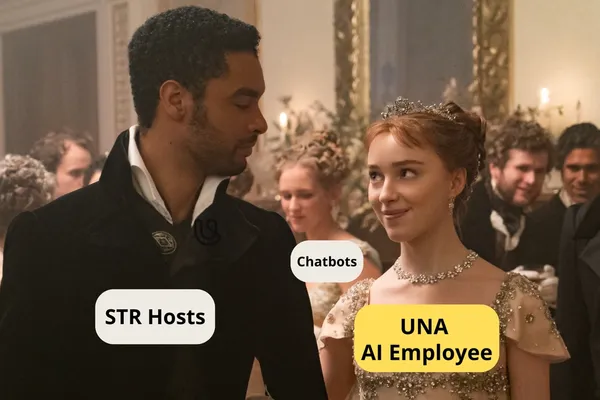
WhatsApp and Web Chat for Hotels: When AI Can Actually Do the Work

A guest sends your hotel a WhatsApp message at 10:30 PM.
"Can I extend my stay until Monday?"
Your chatbot replies immediately, explains the hotel's extension policy, and offers to forward the request to reception.
The guest gets an answer in seconds.
But the reservation hasn't changed. Availability hasn't been checked. And someone on the morning shift still needs to finish the job.
The message was automated. The work wasn't.
This is one of the most overlooked problems in hotel guest communication. Properties introduce WhatsApp chatbots and website assistants to reduce the workload on their teams, only to discover that employees are still handling the same operational tasks behind the conversations.
For hotels, serviced apartments, and professional vacation rental operators, the bigger opportunity isn't simply responding faster.
It's connecting guest messages to the reservations, service requests, and operational workflows that make those responses useful.
What Can a WhatsApp Chatbot for Hotels Actually Do?
A WhatsApp chatbot allows guests to communicate with a hotel through WhatsApp without requiring an employee to write every response.
Depending on the product and its integrations, it can answer frequently asked questions, share property information, collect guest details, send booking links, and route requests to the appropriate team.
For hotels that receive large volumes of repetitive inquiries, these capabilities can be valuable.
Guests can quickly find out when breakfast starts, whether parking is available, or how late they can check in.
But not every interaction ends with a question.
A guest may want to change a reservation, extend their stay, arrange an early arrival, or report a maintenance problem.
These requests require more than information.
They require an action in a booking system, a task for an operational team, or a decision from someone authorized to make it.
The difference between a useful messaging bot and an operational AI agent is what the system can do after understanding the request.
Some advanced chatbots already offer transactional capabilities. The label alone doesn't tell you how much work a product can complete.
The practical test is whether the system can execute the relevant workflow through supported integrations or whether it simply passes the request to an employee.
Why WhatsApp and Website Chat Matter for Direct Bookings
WhatsApp and website chat are often treated as guest support channels.
But both can also be part of the hotel's direct booking journey.
Consider a traveler browsing your website.
They've found a room that looks suitable, but they want to confirm whether parking is included or whether the hotel can accommodate a late arrival.
If the answer isn't immediately available, they may need to call reception, send an email, or continue comparing other properties.
A website AI assistant can help address those questions while the guest is still considering the reservation.
WhatsApp provides another opportunity to continue the conversation on a familiar mobile messaging platform.
The commercial value comes from reducing unnecessary steps between booking intent and the next action.
For example, an AI assistant with a compatible booking integration may be able to:
- Answer questions about available accommodation.
- Retrieve relevant rates and reservation conditions.
- Help guests compare suitable room options.
- Send supported booking or payment links.
- Complete authorized reservation actions.
- Provide appropriate confirmation or follow-up information.
The exact workflow depends on the PMS, booking engine, messaging provider, and property configuration.
Sending a booking link doesn't guarantee a reservation, and faster response times don't automatically prove higher conversion.
But connecting communication with booking execution creates a more complete process than answering the initial question and leaving everything else to staff.
The objective is to make direct booking easier, not simply make the chatbot faster.
Five Guest Requests That Reveal the Difference Between a Bot and an AI Digital Employee
The easiest way to evaluate hospitality messaging automation is to test realistic guest requests.
Here are five scenarios that illustrate the difference between automated communication and operational execution.
1. "Can I Check In Early or Check Out Late?"
An early arrival request may sound simple, but approving it can depend on availability, existing reservations, housekeeping schedules, and property policies.
A basic chatbot may explain the early check-in policy and advise the guest to contact reception.
An execution-focused AI agent can potentially retrieve relevant booking information, check supported conditions, present an eligible offer, and initiate the next step.
Where the connected systems permit it, that might include updating a reservation or supporting payment for an approved service.
But the AI should not promise a room will be ready without reliable information or the authority to make that commitment.
If housekeeping confirmation or managerial approval is required, the request should be routed accordingly.
For operators, the advantage is not eliminating human involvement in every early arrival request.
It's reducing the amount of manual coordination needed for routine, policy-compliant cases.
2. "I Need to Change My Reservation Dates"
A guest asks to move their arrival from Friday to Saturday.
The chatbot collects the information and forwards it to the reservations team.
An employee must still retrieve the booking, check availability, apply the relevant rate conditions, and make the modification.
This is where PMS integration becomes critical.
An AI Digital Employee connected to a compatible system can support reservation modifications when the action is available and authorized.
The workflow may include identifying the booking, verifying the relevant conditions, checking updated availability, making the change, and communicating the result.
Not every reservation can be modified in the same way.
Bookings originating from different channels may have restrictions, and some changes require guest or staff approval.
The important distinction is whether the AI can complete the permitted action, not simply describe how an employee would complete it.
3. "The Water Heater Isn't Working"
This request has nothing to do with booking conversion.
But it's an excellent test of operational automation.
A chatbot can acknowledge the issue and reassure the guest that the hotel will look into it.
The actual problem remains until someone takes action.
With an appropriate operational integration, an AI Digital Employee can capture the issue, identify the relevant property or room, and create or route a structured maintenance request.
The maintenance team still needs to assess and repair the problem.
But the message doesn't have to remain buried in a conversation until an employee manually transfers it.
For multi-property operators, this is particularly relevant because the person handling guest communication may not be the person responsible for the property.
4. "I'm Arriving Late. How Do I Get In?"
Late-arrival instructions often involve property-specific information.
One hotel may operate a staffed reception overnight. Another may have a self-check-in process. A serviced apartment may use a building entrance code or another access arrangement.
A simple chatbot might provide general arrival instructions.
A connected AI agent can use relevant reservation and property information to provide the appropriate instructions when permitted.
However, access information may be sensitive.
The workflow should account for reservation status, identity verification where required, and the property's established access procedures.
The objective is to help legitimate guests arrive smoothly without bypassing operational or security rules.
5. "Do You Allow Pets?"
A question about pets seems like a straightforward FAQ.
But for a professional vacation rental manager, the answer may depend on the specific property.
One apartment may accept dogs below a certain size. Another may have restrictions on the number of animals. A third may require an additional fee.
The AI needs to apply the rules for the correct property rather than provide a generic answer.
If the guest's circumstances require an exception, an employee may need to approve it.
This is a useful reminder that operational AI doesn't need to perform a complicated transaction in every conversation.
Sometimes its most important responsibility is applying the right rule and knowing when not to make a commitment.
How Una Connects WhatsApp and Web Chat to Hotel Operations
Una by Polydom is a voice-first AI Digital Employee designed to work within the hospitality technology stack operators already use.
Una supports guest communication through compatible channels, including WhatsApp and website voice or text interactions.
Her role extends beyond producing responses.
Through supported integrations and configured workflows, Una can retrieve reservation information, execute eligible booking actions, capture operational requests, and escalate situations requiring human judgment.
Consider a guest messaging the hotel about a stay extension.
When the necessary systems and permissions are available, Una can help move the request through the booking process instead of simply forwarding the conversation.
A maintenance request can become a structured task for the appropriate team.
A prospective guest can receive relevant booking information and continue toward a reservation.
The available actions depend on the property's PMS, communication integrations, operating rules, and deployment configuration.
For example, Una's integrations with hospitality systems such as Apaleo, Guesty, Hospitable, and Zeevou support different operational workflows. Operators should confirm the precise capabilities available with their existing systems.
Una's value isn't that she adds another messaging interface. It's that she is designed to perform work using the systems the hotel already relies on.
Learn how Una connects to a hotel's PMS and operational technology.
Why WhatsApp and Web Chat Still Need a Voice Strategy
Not every guest wants to type.
A traveler comparing extended-stay options may prefer to call and discuss rates.
Someone with an urgent problem may reach for the phone rather than send another message.
And prospective guests may call because they have questions they don't want to resolve through several written exchanges.
That is why hotels should evaluate their communication strategy based on actual guest demand rather than assuming one digital channel is sufficient.
A WhatsApp chatbot may handle routine written inquiries effectively while telephone bookings still depend entirely on staff availability.
A website assistant may reduce basic questions without addressing incoming calls.
For operators, those are separate sources of workload.
What Real Hotel Call Data Reveals
In a separate analysis, Polydom examined 15,910 incoming calls across 15 AI voice agents over 175 days in a European hotel network.
One unexpected finding involved the removal of an existing IVR menu.
When the menu was removed, the reported empty call rate increased to 19.5%.
The change revealed that some callers who previously disconnected before reaching the AI had not been included in the AI's reporting.
The lesson was not that voice AI had suddenly become less effective.
It was that the hotel's telephone infrastructure had created a measurement blind spot.
For hospitality operators, this illustrates why phone coverage deserves its own evaluation rather than being treated as a secondary feature of a messaging product.
Read what 15,910 hotel calls revealed about AI voice agents.
An effective communication strategy may combine voice and digital channels, but each should be configured and tested for its own operational requirements.
What About Continuous Guest Context Across Channels?
Guests don't think in terms of channel integrations.
They might begin a conversation through website chat, continue through WhatsApp, and call the hotel later.
From the guest's perspective, they're communicating with the same business about the same stay.
But those interactions may arrive through different systems.
A useful AI deployment needs a reliable way to access the relevant reservation and interaction context.
That doesn't mean every message is automatically shared across every channel.
Cross-channel continuity depends on identifying the guest appropriately, retrieving authorized information, and connecting compatible systems.
When the necessary context is available, an AI Digital Employee can reduce repetitive questions and help employees understand what has already happened.
For example, a guest following up on a service request should not need to explain the entire issue again when a relevant operational record is available.
At the same time, the system should not assume two contacts belong to the same person without sufficient evidence.
Good continuity depends on accurate context, not simply remembering more information.
Kiosk Mode: Another Guest Touchpoint, Different Requirements
Website chat and WhatsApp are not the only places where guests may interact with an AI employee.
Hotels can also provide access through supported kiosk or tablet configurations.
A lobby kiosk can help guests find property information, ask routine questions, or initiate supported service requests.
However, a shared device introduces requirements that differ from a guest's personal phone.
The next user should not be able to access the previous guest's private conversation.
Una's Kiosk Mode includes configurable session-clearing functionality intended to help prevent conversational history from remaining visible between users.
That is a useful safeguard, but it should form part of a wider approach to privacy, session management, and secure access.
The broader lesson is that each communication channel needs operational controls suited to the way guests use it.
A website widget, a WhatsApp conversation, a telephone call, and a public kiosk are not interchangeable environments.
For more on why channel-specific deployment matters, read 100 Emails at 3 AM: What Every New Channel Teaches You About AI Deployment.
What Real Operations Tell Us About AI Communication
A useful hotel messaging solution should be evaluated by what happens after the initial response.
At Lee Gardens Extended Stay in Orlando, Florida, Una was deployed to handle guest communication, direct reservations, and operational requests across supported channels.
Over a ten-month reporting period, the hotel recorded:
- 4,104 guest conversations handled by Una.
- 2,475 phone calls handled.
- 232 direct reservations made by Una.
- $80,968 in reported direct booking revenue associated with those reservations.
- 172 operational tasks generated for hotel employees.
- 80 conversations requiring human interaction, approximately 1.95% of the total.
These results describe the overall Lee Gardens deployment, not the isolated performance of WhatsApp or website chat.
They do not prove a specific conversion lift from either messaging channel, and the reported booking revenue should not be treated as guaranteed incremental revenue.
What they do demonstrate is the combination of communication, booking execution, and operational coordination in a live hotel environment.
Explore the Lee Gardens customer case study.
For operators choosing a WhatsApp or web chat solution, that's a more useful outcome to examine than response speed alone.
How to Choose WhatsApp and Web Chat Automation for Your Hotel
Before selecting a vendor, begin with the guest requests your team handles every day.
Then ask for a demonstration that includes the operational action behind the conversation.
The following questions can help distinguish a communication tool from a more complete AI workflow solution.
Can It Complete a Booking Action?
Ask the vendor to demonstrate a guest changing reservation dates or completing an eligible direct booking.
Check whether the action actually appears in the connected PMS.
A successful chatbot response isn't proof that the reservation changed.
Can It Create and Route a Service Task?
Use a realistic maintenance or housekeeping request.
Ask where the information goes, who receives it, and which parts of the process remain manual.
Which Channels Support the Same Workflows?
Check whether WhatsApp, website chat, email, and telephone integrations support the specific actions your operation requires.
Avoid assuming that adding another channel automatically reproduces every existing capability.
What Happens When the AI Needs Help?
Test an exception requiring managerial approval.
The system should recognize the limit of its authority and provide an appropriate route to human assistance.
How Are Property Rules Applied?
Use difficult scenarios involving different cancellation policies, pet restrictions, rates, or arrival procedures.
A reliable system should use the correct information for the relevant property.
How Is Performance Measured?
Look beyond message volume and response time.
Useful indicators include completed booking actions, human escalations, structured tasks generated, unresolved repeat requests, and operational workload.
What Is Required to Go Live?
Ask about PMS integrations, channel connections, property knowledge, testing, employee training, and ongoing oversight.
A demonstration that works in one environment does not automatically prove readiness for your operation.
For a broader evaluation framework, read How to Choose a Hotel AI Chatbot: 10 Criteria That Actually Matter.
Frequently Asked Questions
Can a WhatsApp Chatbot Make Hotel Reservations?
Some WhatsApp AI solutions can support reservations through compatible PMS or booking-system integrations.
Capabilities vary. A chatbot may only send a booking link, while an execution-focused agent can potentially create a reservation in a connected system.
Operators should verify the specific workflow before deployment.
Is WhatsApp Better Than Website Chat for Hotels?
Neither channel is universally better.
Website chat can assist visitors while they browse the property's site. WhatsApp can support conversations through a familiar messaging application.
The right choice depends on guest behavior, booking demand, operational needs, and the integrations available.
Many properties benefit from using both.
Can Hotel AI Chatbots Handle Early Check-In and Late Checkout?
Yes, to varying degrees.
Some tools provide policy information or forward requests to staff. Others can check relevant conditions and support authorized booking or service workflows through connected systems.
Physical room readiness and exceptions may still require employee involvement.
Does Una Work With WhatsApp and Website Chat?
Yes. Una supports WhatsApp through compatible messaging integrations and website-based voice or text communication.
The specific actions available depend on the property's connected systems, permissions, and configuration.
Can a Hotel AI Agent Replace Front Desk Employees?
An AI agent can reduce repetitive communication and supported administrative tasks, but employees remain responsible for physical service delivery, complex exceptions, guest relationships, and decisions requiring human judgment.
The objective is better operating capacity, not removing people from hospitality.
The Real Test: What Happens After the Guest Hits Send?
WhatsApp and website chat can make it easier for guests to reach a hotel.
But availability isn't the same as operational capability.
A fast response doesn't update a reservation.
A polite acknowledgment doesn't dispatch maintenance.
A booking suggestion doesn't become revenue until the guest completes the transaction.
For hotel operators, the next step in messaging automation is to connect those conversations to the systems and people responsible for delivering the service.
That is the difference between using AI primarily as a communication interface and using it as an operational employee.
Una by Polydom is designed around that distinction: a voice-first AI Digital Employee capable of handling supported guest communication and execution workflows within existing hospitality systems.
The goal isn't simply to answer more messages. It's to leave fewer guest requests unfinished.
See How Una Handles Guest Messages and Operational Workflows
Want to understand what happens when a guest asks Una to change a booking, request a service, or continue a reservation through a digital channel?
Talk to our team about your existing PMS, communication channels, and operational requirements.
Book a quick call with the Una team to explore which WhatsApp, website chat, and booking workflows Una can support at your property.