What Hotel Reports Miss: Insights Hidden in Guest Conversations
Introducing Polydom MCP: Connect Una to ChatGPT or Claude and turn everyday guest interactions into useful business insights.
Your guests may know more about what's happening at your property than your weekly reports reveal.
They know which check-in instructions are confusing, which amenities aren't working, what services they wish they could book, and why they sometimes need to speak with a human.
They share this information every day.
But for a hotel manager overseeing dozens or hundreds of rooms, reviewing every guest conversation is simply not practical.
And missing these patterns can have real business consequences: recurring complaints, unnecessary work for staff, missed revenue opportunities, and operational problems that go unnoticed.
What if you could simply ask your AI what guests have been telling it?
That's the idea behind Polydom MCP, a new integration that connects information from Una, Polydom's AI Digital Employee, to your own ChatGPT or Claude.
Instead of searching through hundreds of conversations or comparing multiple reports, you can ask questions in natural language and explore what guest interactions reveal about your business.
Una Does the Work. Now You Can See What That Work Reveals.
Una is more than a hotel chatbot, or Co-pilot, or AI agent.
She's an AI Digital Employee developed to handle real operational workflows across hotels, serviced apartments, and vacation rental businesses.
Una manages reservations, coordinates your team workflow, helps guests with requests, and escalates situations when human assistance is needed.
And while Una is doing this work, those interactions create valuable information about your property's operations.
A guest asking about early check-in may reveal demand for an additional paid service. Repeated questions about access codes might indicate that arrival instructions need improvement. Booking conversations can show how Una contributes to reservation activity.
Until now, understanding these patterns often required reviewing individual conversations or working with separate reports.
With Polydom MCP, you can investigate them directly through ChatGPT or Claude.
The distinction is important: Una continues performing operational work, while your connected AI assistant helps you understand the information generated through that work.
Imagine Asking ChatGPT What Actually Happened at Your Property Last Week
Monday mornings in hospitality tend to come with a familiar ritual: reviewing bookings, checking messages, catching up with the team, and trying to understand what happened over the weekend.
Now imagine opening ChatGPT and asking:
"How did Una perform last week compared to the week before?"
With Polydom MCP connected, your assistant can examine available activity from your properties, including conversation volumes, booking records, communication channels, and requests handed over to your team.
You could then ask:
"Why did guest inquiries increase?"
Maybe the number of conversations increased because more guests were requesting early check-in. Or perhaps several properties received repeated questions about how to access their apartments.
Then follow up:
"Which properties generated the most of these requests?"
Instead of opening another report every time a new question comes up, you can continue investigating through the same conversation.
And the most useful part comes next: understanding what the information means for your business.
Frequent access questions may indicate a process that needs fixing. Repeated requests for an additional service may reveal a revenue opportunity. A sudden increase in human handoffs may show where Una needs clearer instructions.
The goal isn't just to find information faster. It's to understand what needs attention and decide what to do about it.
Five Business Questions Worth Asking Your AI
One of the biggest advantages of Polydom MCP is that you don't need to know which report to open before looking for answers.
You can start with a business question and explore the information available through Una.
1. "What did guests complain about most last month?"
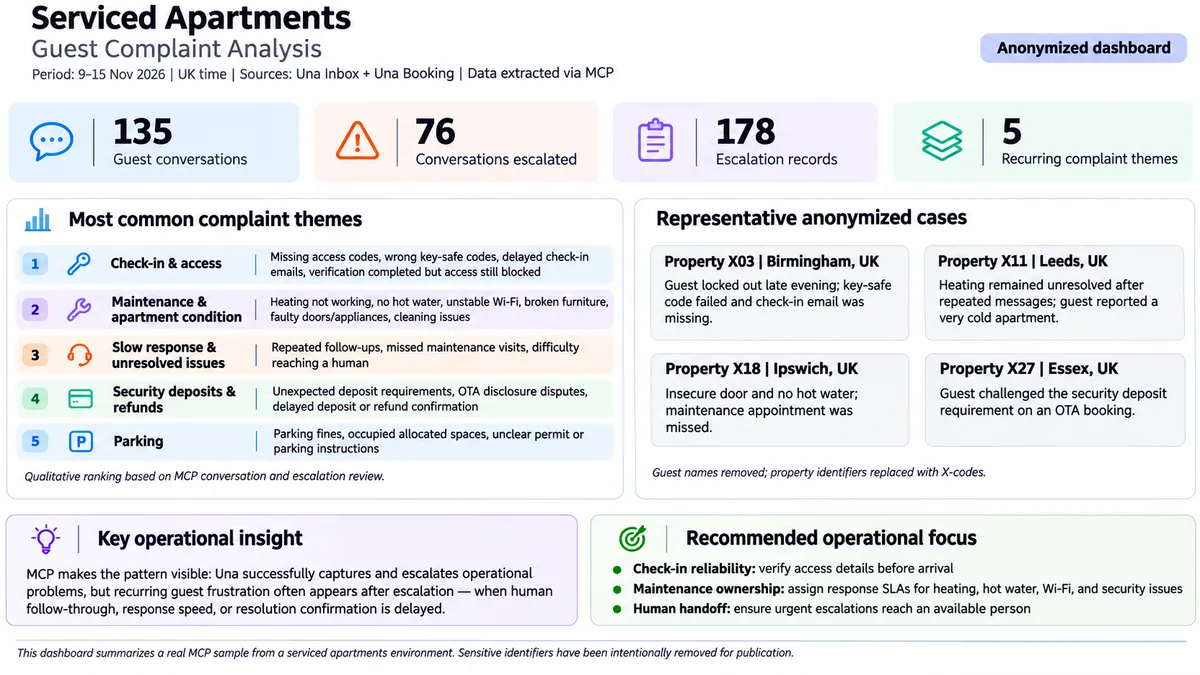
One complaint about a broken appliance might be an isolated incident. Repeated complaints about similar issues could point to a recurring operational problem.
Your connected AI assistant can help group relevant conversations and identify common issues such as cleaning delays, noise, heating problems, or confusing check-in instructions.
You can then investigate which properties are affected and review the original interactions.
The business value: Identify recurring problems earlier, prioritize improvements, and reduce the risk of the same issues affecting more guests.
2. "Why does Una keep transferring guests to my team?"
Human handoffs aren't necessarily a sign that something went wrong.
Sometimes guests simply want to speak with a person. In other cases, the reason may be incomplete instructions, missing information, or a situation that genuinely requires human judgment.
Understanding the difference matters.
If conversations are repeatedly transferred because guests ask the same question, the solution may be to improve Una's knowledge base rather than continue handling each request manually.
The business value: Reduce avoidable interruptions, improve operational consistency, and allow employees to focus on requests that genuinely require human attention.
3. "How many bookings did Una create, and what were they worth?"
An AI employee should be evaluated by more than the number of messages it answers.
Polydom MCP allows your connected AI assistant to examine available booking records, associated amounts, and activity across different periods.
You can ask how many bookings Una created last month, review the recorded booking values, or compare reservation activity between periods.
This provides a more commercially relevant picture than conversation volume alone.
The business value: Gain better visibility into reservation activity supported by Una and evaluate her contribution using meaningful business indicators.
4. "Which apartments had the most maintenance-related complaints?"
For operators managing multiple properties, recurring maintenance issues can be difficult to identify across individual conversations.
A guest mentioning a heating issue may appear to be an isolated service request. But if several guests report similar problems at the same property, that pattern deserves attention.
Your AI assistant can help identify recurring maintenance-related conversations and the properties involved.
Your team can then review the evidence, verify the problem, and decide what work needs to be scheduled.
The business value: Prioritize maintenance investigations, reduce repeated guest complaints, and improve consistency across a portfolio.
5. "Which additional services do guests ask for most often?"
Early check-in. Late checkout. Parking. Extra cleaning. Transportation.
Guests may already be telling you which services they value.
For example, repeated requests for early check-in could indicate demand for a paid option. Frequent questions about airport transfers may suggest an opportunity to offer transportation services through a local partner.
Exploring these requests gives operators a starting point for evaluating additional services based on actual guest demand rather than assumptions.
The business value: Identify potential upselling opportunities, evaluate new revenue streams, and adapt your offering to what guests are requesting.
From Guest Conversations to Operational Decisions
The real value of this information isn't simply knowing what guests said. It's understanding what should happen next.
Consider a practical example.
Suppose a hotel manager notices that Una has been escalating multiple conversations involving late arrivals.
Rather than treating every handoff as a separate incident, the manager could use Polydom MCP to investigate:
- How many late-arrival conversations required human assistance?
- Which properties generated those requests?
- What information were guests asking for?
- Were the relevant arrival instructions available to Una?
The answers could reveal that guests at particular properties repeatedly need clarification about access procedures.
The operations team could then review the instructions, correct any missing information, and update Una's knowledge base.
The following week, the manager could compare the number of similar handoffs to see whether the change had an effect.
This is an illustrative workflow, not a claim about a specific customer deployment.
This is where analytics becomes operationally useful.
The manager identifies a recurring issue, investigates the evidence, makes an improvement, and measures the result.
Una continues handling guest interactions. Human managers retain control over decisions and operational changes.
That's how everyday guest conversations can become a source of continuous operational improvement.
What Happens When Your Business Tools Connect to the Same AI?
Polydom MCP uses Model Context Protocol (MCP), an open standard that enables compatible AI applications to connect to external sources of information.
That matters because Una is rarely the only technology a hospitality business relies on.
Operators typically use a property management system, accounting software, maintenance tools, and other applications. Each holds a different piece of operational information.
When those systems provide compatible MCP connections, an AI assistant may be able to work with information from multiple sources in the same conversation.
Imagine asking:
"Which apartments received the most guest complaints while also recording the lowest occupancy last quarter?"
Una's records could provide the guest communication information, while a separately connected PMS could provide occupancy figures.
The ability to combine those perspectives depends on the other systems, their supported integrations, and the permissions available to the AI assistant.
But the opportunity is clear: managers can begin exploring business information across their technology stack without treating every platform as an isolated destination.
And there's an important distinction between accessing information and taking operational action.
Polydom MCP gives your connected assistant access to permitted information from Una. It does not turn that assistant into another operator of your hotel's systems.
Una remains the Digital Employee responsible for her supported operational workflows.
And No, Your ChatGPT Can't Suddenly Change Your Hotel Settings
Connecting business information to an AI assistant should never mean giving it unrestricted operational control.
That's why Polydom MCP is designed with read-only access.
Through this integration, ChatGPT or Claude can retrieve information made available through Polydom, but cannot use the Polydom MCP connection to:
- Send messages to guests
- Create, cancel, or modify reservations
- Change Una's instructions
- Update your Polydom settings
Each person connects through their own account, with access based on their existing Polydom permissions.
Connections can also be revoked from the platform.
Users should also review the applicable access requirements and data-handling terms of their chosen AI service.
In other words, Una continues handling guest-facing work, while your connected AI assistant helps you understand the data behind it.
Not Using Una Yet? Meet the AI Employee Behind the Insights.
If you're exploring AI for your hotel or vacation rental business, there's a bigger opportunity here than simply adding another analytics tool.
Imagine having an AI Digital Employee that manages guest conversations across multiple channels, supports reservations, coordinates routine requests, and knows when to involve your human team.
Now imagine being able to explore what that work reveals about guest expectations, recurring operational problems, and potential revenue opportunities.
That's what makes Una different from a traditional FAQ chatbot or Co-pilot.
She isn't just there to answer a question and end the conversation. She's designed to support real hospitality workflows, while the information generated through her work helps you better understand your business.
The goal isn't to remove people from hospitality.
It's to create a more effective way of working, where Digital Employees handle repeatable digital tasks and human teams focus on hospitality, relationships, and decisions that require judgment.
Whether you operate a boutique hotel, serviced apartments, or a growing vacation rental portfolio, Una can help you rethink how guest communication and operational execution fit into your business.
Your Guests Are Already Giving You Valuable Insights. Don't Let Them Go Unnoticed.
Every conversation tells you something.
What guests need. What's causing friction. Which services attract interest. Where your team may be spending unnecessary time.
The challenge has never been a lack of information.
It's been finding a practical way to use it.
Una helps hospitality businesses manage guest interactions and operational workflows. With Polydom MCP, those interactions become a more accessible source of business insight through ChatGPT or Claude.
Una does the work. Now you can see what that work means for your business.
Tagged