From Chatbots to Digital Employees: How AI Is Transforming Hotel Operations
Artificial intelligence is becoming an essential part of modern hospitality operations, but its role is changing. While early AI solutions focused primarily on answering guest questions and automating communication, a new generation of technology is capable of completing operational tasks, coordinating hotel departments, and working directly with property management systems.
This evolution from chatbots to AI Digital Employees represents a significant shift in how hotels approach automation. Rather than introducing another tool for employees to manage, hotels can delegate specific digital responsibilities to AI while allowing their teams to focus on guest experience, complex decisions, and personalized service.
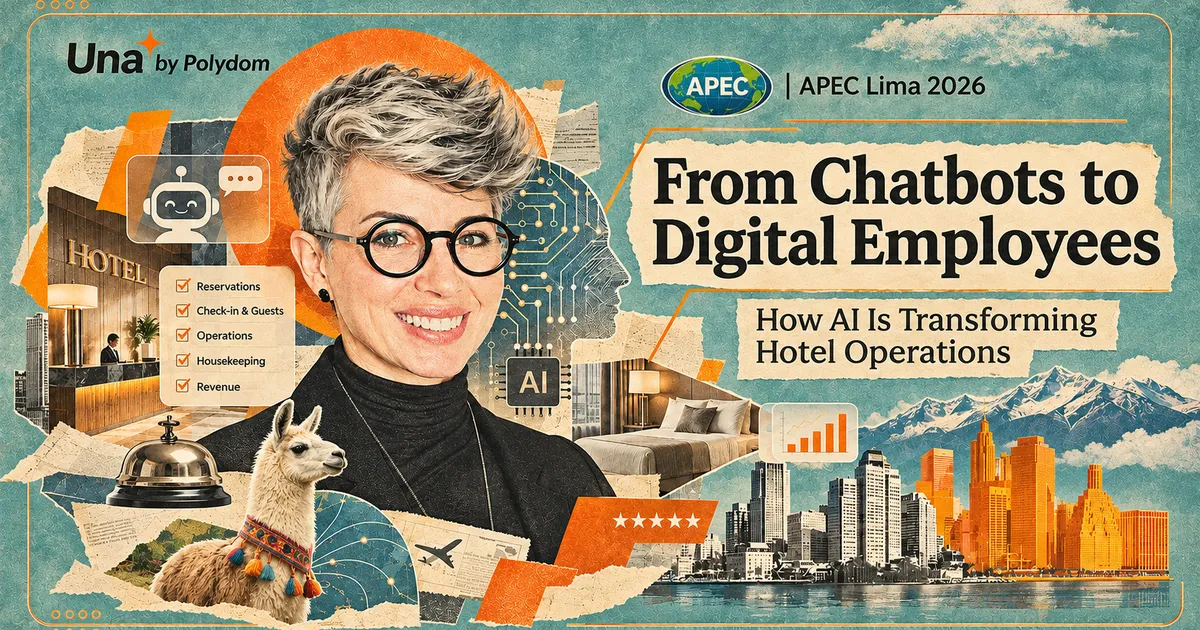
The future of this transformation was among the topics discussed at the APEC workshop on AI-based solutions for hospitality operations, held in Lima, Peru, on November 5–6, 2026. The event brought together hospitality professionals, technology providers, and policymakers to explore how artificial intelligence can improve operational efficiency across APEC economies while supporting workforce development and responsible technological adoption.
Lana Udalov, Co-Founder and CEO of Polydom, joined the discussion to share practical experience from implementing Una, an AI Digital Employee for hotels and short-term rentals, including real hotel workflows, measurable operational results, and lessons learned from hospitality partners.
One idea was central to the conversation: the real value of AI in hospitality should not be measured by how much human interaction it replaces, but by how much time it gives people back.
From Chatbots to Digital Employees: Understanding the Difference
The hospitality industry has already adopted various forms of artificial intelligence, from website chatbots to automated guest messaging and reservation assistants. However, these technologies differ considerably in the level of responsibility they can assume.
A chatbot provides information and responds to questions. An AI copilot supports employees by helping them retrieve information or make decisions. An AI agent can execute individual tasks through connected software. An AI Digital Employee goes further by performing defined operational roles within established permissions, hotel policies, and performance standards.
The distinction becomes clearer when considering a typical hotel reservation inquiry. A chatbot might explain room availability or cancellation policies, while an AI agent could complete a specific booking action. A Digital Employee can manage the broader workflow, from understanding the guest's requirements and checking applicable rules to creating the reservation, recording relevant details, and confirming the outcome.
In this model, the AI is evaluated not only on the quality of its communication but also on whether it completes its assigned work accurately and consistently.
A Digital Employee is defined by operational responsibility, not simply conversational ability.
For hotels, this changes how AI technology fits into daily operations. Instead of requiring employees to switch between multiple systems to process routine requests, Digital Employees can perform authorized actions through connected hotel software and provide visibility into the results.
How AI Digital Employees Work Across Hotel Departments
Hotel operations involve numerous interconnected processes. A single guest request can require information from reservations, front office, housekeeping, maintenance, or other departments. Traditionally, employees coordinate these processes through phone calls, emails, internal messages, and different software platforms.
AI Digital Employees offer a different approach by supporting multiple operational roles through a shared knowledge base and approved system integrations.
For example, Una can support front desk and guest services by responding to inquiries, handling routine requests, and routing situations that require personal attention. Within reservations, she can assist with bookings, modifications, confirmations, and group reservation workflows.
Her responsibilities can also extend beyond direct guest communication. In housekeeping, Una can create and coordinate cleaning tasks, while in maintenance operations, she can register requests, notify the appropriate team, and track progress. Other supported workflows include in-room dining requests, sales coordination, and approved guest follow-ups.
The advantage of this model is continuity. Information collected during one interaction can support subsequent authorized tasks without requiring hotel staff to repeatedly transfer the same details between departments.
However, this does not eliminate the need for human employees. Physical room preparation, repairs, sensitive guest complaints, complex negotiations, and decisions requiring professional judgment remain human responsibilities.
The objective is to distribute work more effectively between digital and human employees, allowing each to focus on the tasks they are best equipped to perform.
Real Hotel Automation: From Guest Inquiry to Confirmed Reservation
One of the clearest examples of AI Digital Employees in practice comes from a hotel in California, where Una manages guest inquiries through a voice channel and interacts with the property's Mews PMS.
During one guest conversation, a caller wanted to know whether they could bring a dog to the hotel. Una explained the property's pet policy, including the applicable fees and restrictions, and continued assisting the guest with their reservation.
After collecting the necessary information and applying the hotel's approved rules, Una created the booking directly in the PMS. The reservation, recorded under confirmation number 4414, included the stay details and relevant information about the guest's pet and approved fee.
The entire process moved from a natural phone conversation to an operational action within the hotel's existing software.
This example illustrates an important distinction between conversational AI and practical hotel automation. The value was not simply that Una answered the guest correctly; she completed the reservation workflow and recorded the necessary information for hotel operations.
Such capabilities are particularly relevant for independent hotels, where a limited team may need to handle reservations, guest communication, and operational coordination simultaneously.
By delegating appropriate digital tasks, hotels can maintain consistent service across communication channels while reducing the administrative workload placed on their employees.
Measuring AI in Hospitality: Real Operational Results
As AI becomes more involved in hotel operations, hospitality businesses need a more meaningful way to evaluate its performance.
Traditional chatbot metrics, such as response time, conversation volume, or the percentage of inquiries answered automatically, provide only part of the picture. They do not necessarily indicate whether a reservation was created correctly, a maintenance request reached the right department, or an operational issue was successfully resolved.
A practical example comes from a 68-room hotel in Germany, where Una operates alongside Apaleo PMS.
Over a 30-day period, Una's recorded activities represented an estimated 56 hours and 45 minutes of human-equivalent administrative work, corresponding to approximately 7.1 eight-hour working days.
The workload was distributed across three operational areas:
Operational area
Estimated human-equivalent workload
Guest communication, including email
17h 15m
Operations and dispatch, including housekeeping and maintenance
31h 24m
Reservations and billing
8h 06m
Total
56h 45m
These estimates are based on recorded activities and estimated human processing times, rather than directly measured staffing reductions.
What makes the results particularly interesting is that the largest share of the workload was associated with operations and dispatch, not guest communication.
This demonstrates an often-overlooked opportunity for AI in hospitality. While guest-facing automation attracts much of the industry's attention, substantial administrative work takes place behind the scenes through task coordination, information management, and operational follow-ups.
For hotels evaluating Digital Employees, the most useful performance indicators therefore extend beyond the number of calls or messages handled. They include successful task completion, execution accuracy, compliance with hotel policies, appropriate escalation to human employees, correction frequency, and cost per completed task.
A Digital Employee should also recognize when a request exceeds its authorized responsibilities. In these situations, transferring the task to a human colleague is a necessary part of reliable performance rather than a failure of automation.
Why Successful AI Implementation Requires More Than Technology
Introducing an AI Digital Employee into a hotel is not simply a matter of connecting software and activating automated conversations.
Hospitality operations involve complex pricing structures, cancellation policies, corporate agreements, payment requirements, and exceptions that may differ from one property to another. Much of this knowledge is often held informally by experienced employees rather than documented in a structured format.
For a Digital Employee to perform reliably, hotels need clear standard operating procedures, accurate operational data, defined permissions, and processes for verifying completed actions.
This preparation frequently brings additional operational benefits because it encourages hotels to review the complexity of their own workflows.
At Hotel Ladenmühle in Germany, Managing Director Helena Petzold described how Una handles initial rate inquiries and communicates relevant pricing information before staff intervention is required. As a result, employees can focus on unresolved guest needs instead of repeating routine administrative steps.
The implementation also encouraged the property to review and simplify its rate structure, including corporate rates. Clearer rules can make daily operations easier for both the hotel's employees and its Digital Employee, while improving consistency for guests.
A similar lesson emerged at Lee Gardens Extended Stay, where Managing Partner Michael Averbukh emphasized the importance of preparing staff to work alongside AI.
Hotel employees do not need to become AI specialists. They need to understand what their digital colleague has already completed, what remains unresolved, and when their input is required.
These experiences highlight why successful AI adoption involves both technological and organizational change. Digital Employees can reduce repetitive work, but their effectiveness also depends on the quality of the processes and information supporting them.
The Hybrid Workforce: How Human and Digital Employees Will Work Together
As AI Digital Employees take on more operational responsibilities, hospitality businesses will increasingly need to organize work around collaboration between people and technology.
This emerging model is known as the Hybrid Workforce, where human and Digital Employees operate as part of the same team, with clear responsibilities, supervision, and accountability.
In practice, Digital Employees manage authorized digital workflows, while hotel staff remain responsible for personal service, complex decisions, physical operations, and situations requiring empathy or professional judgment.
Preparing for this transition requires more than technical integration. Hospitality schools, universities, and professional training organizations will need to help future employees develop the skills required to delegate work, supervise automated processes, and manage handoffs between digital and human colleagues.
Hotels will also need clearer governance standards covering access permissions, operational responsibilities, auditability, and measurable performance outcomes. Technology providers, meanwhile, must support secure interoperability so Digital Employees can perform approved actions across hotel systems.
These priorities are becoming part of a wider conversation about responsible AI adoption in tourism. In Peru, the Ministry of Foreign Trade and Tourism, MINCETUR, has been advancing a national framework for AI adoption in the tourism sector, reinforcing the importance of collaboration between government, industry, and technology stakeholders.
Making the Hybrid Workforce accessible to independent hotels and smaller hospitality businesses will be especially important. Practical implementation guidelines, workforce training, and pilot programs can help properties adopt AI responsibly without requiring extensive internal technology resources.
The Future of AI in Hospitality Is About People
The growing capabilities of AI Digital Employees create opportunities for hotels to improve operational efficiency, manage administrative responsibilities more consistently, and reduce the burden of repetitive digital tasks.
However, successful implementation depends on approaching AI as part of the hotel team rather than as a standalone technology solution.
Alexander Herold of Avaneo Hotels offered a practical perspective based on his property's experience. His advice to independent hoteliers was to begin with clearly defined tasks, evaluate how much meaningful work AI removes from employees, and continuously improve both the technology and existing hotel procedures.
The long-term opportunity is not simply to automate more interactions, but to create hotel operations where technology supports the people delivering hospitality.
For Polydom, this principle shapes the development of Una and the broader vision for AI Digital Employees. When digital responsibilities are managed effectively, hotel teams gain more capacity to focus on what technology cannot replicate: personal attention, thoughtful service, and genuine human connection.
As Lana Udalov emphasized during APEC Lima 2026, artificial intelligence should ultimately give people something valuable: more time for their guests, their families, and the experiences that matter most.
Digital to Digital. Human to the Guest.
Tagged