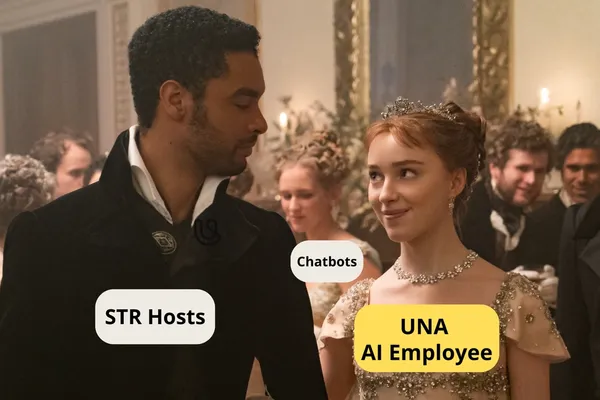
Your STR Business Runs on People Remembering Things. That's the Risk.

A senior property manager knows that the security desk at one building won't release keys after 10 PM.
Your booking coordinator remembers that the local tax rules changed three weeks ago.
A cleaner knows that the water heater in Apartment 47 needs to be reset before every arrival.
None of this is written down.
The operation runs smoothly because experienced people remember what the systems don't.
Until someone goes on vacation. Or leaves the company. Or your portfolio grows by another 50 units.
Suddenly, what looked like a well-managed short-term rental business starts revealing its real operating model: a collection of people holding disconnected processes together.
The biggest scalability risk in short-term rentals isn't always the number of properties. It's how much of the operation depends on knowledge that lives inside employees' heads.
And this leads to an uncomfortable conclusion.
Short-term rental management looks like hospitality from the outside.
Operationally, it's a coordination business wearing a hospitality costume.
You Don't Manage 100 Apartments. You Manage 100 Sets of Dependencies.
Hotels can be complicated businesses. But many have an operational advantage that professional vacation rental managers lack: a relatively centralized environment.
A hotel may have one building, a front desk, on-site housekeeping, and established internal processes.
A short-term rental portfolio can involve dozens of buildings, multiple booking platforms, external contractors, and property-specific rules that no single system fully controls.
A mid-sized STR operator may depend on eight or more distinct operational components:
- Property management software: Platforms such as Guesty, Hostaway, or Lodgify maintain reservations, availability, and booking information.
- Distribution channels: Airbnb, Booking.com, and direct booking websites have different messaging processes and reservation rules.
- Task management: Systems such as HKeeper, Breezeway, or Operto organize cleaning and operational work.
- Payment processing: Payment providers such as Stripe may handle transactions through workflows separate from the PMS.
- Cleaning and maintenance contractors: External teams may communicate through WhatsApp, email, phone calls, or their own systems.
- Building management: Security desks, reception teams, and access procedures may be controlled by organizations outside the property manager's authority.
- Tax and regulatory requirements: Local obligations can vary between properties and jurisdictions.
- Multilingual guest communication: One portfolio may serve travelers speaking English, Arabic, Swedish, Mandarin, and many other languages.
Each component serves a purpose.
The problem is that they don't necessarily share the same information, operating rules, or understanding of what should happen next.
The PMS may show that a reservation is confirmed.
The payment system may have a separate transaction status.
The building's security team may require additional guest registration.
The cleaner may still be finishing the apartment.
And the guest believes everything is ready because someone said, "Your booking is confirmed."
The property manager's real job is often to prevent these disconnected systems from contradicting one another in front of the guest.
That work is largely invisible when everything goes well.
But it becomes expensive when the portfolio grows.
The Question That Reveals the Entire Problem
Consider a guest sending a single message:
"Hi, when's check-in and how much is cleaning?"
It seems simple.
A chatbot could easily produce a friendly answer.
But for a professional STR operator, answering correctly may require several checks.
First, is the reservation actually confirmed?
A PMS might distinguish between an inquiry, a reservation awaiting payment, a confirmed booking, an expired request, or a canceled stay.
Those states can determine whether access information may be released.
Second, where does the correct cleaning fee live?
It might be stored in a property-level field, included in a rate, or handled differently by the booking channel.
Third, does the quoted amount include applicable taxes?
The current policy may differ from an older template still circulating among employees.
Fourth, does this building have a separate arrival process?
The property manager may be responsible for the accommodation but not authorized to override the building's security procedures.
Finally, has an employee already started handling the conversation?
If so, the AI must not send a conflicting answer.
The guest asked one question.
The operator needed several systems, policies, and people to agree before answering it.
This is why STR automation is harder than generating a good reply. The real work happens before the reply can safely be sent.
For a portfolio managing hundreds of stays, those checks can become a major source of repetitive coordination.
And simply installing a chatbot doesn't remove them.
Four Coordination Failures That Put STR Operations at Risk
After five months of building and refining AI workflows with professional STR operators, we kept encountering four types of failure.
They didn't originate from the same technical problem.
But they shared one characteristic: the guest saw a breakdown in coordination that had previously been hidden inside the operation.
1. Reservation Status Confusion: When the Wrong Guest Gets the Right Instructions
A booking can move through several states before a guest is entitled to receive arrival information.
An inquiry isn't a confirmed reservation.
A booking awaiting payment may not authorize property access.
A canceled reservation should not continue through the normal pre-arrival workflow.
Yet an AI assistant that relies only on conversation history or incomplete reservation information may fail to distinguish these states.
Imagine a guest whose booking has been canceled but who continues receiving arrival instructions.
Or a traveler with an unconfirmed reservation receiving a building access code.
The operational consequences can be serious.
Employees may need to intervene urgently, resolve access disputes, and explain why the information was released.
This isn't primarily a language problem.
It's a failure to connect communication permissions to the correct reservation state.
The business lesson: Before automating guest communication, operators need explicit rules defining what each reservation status permits.
Those rules should be applied consistently across the relevant systems and channels.
An AI agent can support that process, but only when the necessary status information and controls are available.
2. Scope Overreach: When Helpfulness Becomes an Unauthorized Promise
A guest asks whether the property can arrange a birthday cake.
The AI responds enthusiastically.
What flavor would you like?
What should we write on it?
What time should it arrive?
By the time the conversation reaches an employee, the guest believes a cake has been arranged.
But the property manager doesn't provide that service.
No supplier has been contacted.
Nobody approved the arrangement.
The AI has confused understanding a request with accepting responsibility for fulfilling it.
This kind of mistake can create more work than a straightforward refusal.
Now an employee must explain the misunderstanding, manage the guest's expectations, and possibly find a last-minute solution to preserve the relationship.
For professional STR operators, the issue is especially relevant when services depend on external vendors.
A company may offer airport transfers at certain properties but not others.
An early check-in may require cleaning approval.
A special request may involve an owner, building manager, or contractor.
The business lesson: AI must distinguish between services it can confirm, requests it can forward for approval, and arrangements it cannot promise.
Good hospitality doesn't mean saying yes to everything.
It means making commitments the business can actually deliver.
3. Phantom Actions: When Payment Doesn't Mean the Work Is Done
This is one of the most dangerous coordination gaps.
A guest loses their key.
The AI generates a payment link for a replacement.
The guest pays.
The assistant then says the replacement is ready for collection at reception.
But the building's security team hasn't received any instructions.
The guest goes downstairs.
Nobody knows about the replacement.
A digital transaction has been completed, but the physical service has not.
From the guest's perspective, the property manager has failed to deliver something they've already paid for.
From the operator's perspective, several disconnected processes have been mistaken for one completed workflow.
Payment confirmation doesn't prove that a contractor was dispatched.
Task creation doesn't prove that maintenance was completed.
Sending a message doesn't prove that building security accepted the instruction.
These distinctions are fundamental to reliable STR operations.
The business lesson: A workflow shouldn't be marked complete simply because one system completed its part.
The operator needs a reliable way to distinguish requested, approved, paid, dispatched, and fulfilled work when those states apply.
Without that distinction, automation can create promises that nobody is positioned to honor.
4. Human-AI Interference: When Two People Answer the Same Guest
A property manager opens a conversation the AI has been handling.
The manager sends a short reply and returns to another task.
The AI doesn't recognize that a human has intervened.
It continues responding.
Within 90 seconds, the guest receives two messages that contradict each other.
Neither response necessarily looks unreasonable on its own.
Together, they make the operator appear disorganized.
This failure becomes increasingly likely when an organization combines automated guest communication with employees who occasionally take over conversations.
The solution isn't simply better wording.
It's defining ownership of the conversation.
When a human takes responsibility, the AI needs to step back.
When control is returned, automation can resume under the configured rules.
For example, Una's documented Guesty workflow uses conversation assignment to support human takeover and the resumption of eligible automated handling.
The precise behavior depends on the integration and deployment setup.
The business lesson: A guest conversation needs a clear owner at every stage.
Otherwise, an automation tool intended to reduce communication work can become another participant employees must supervise.
The Real Cost Isn't the Mistake. It's Everything That Happens Afterward.
Each coordination failure introduces additional work.
An incorrect access instruction may require urgent intervention.
An unauthorized promise can become a complaint.
A payment without fulfillment creates a service dispute.
Contradictory messages can lead to repeated guest contacts.
The immediate mistake may take seconds.
Resolving the consequences can involve several employees and external parties.
For a professional STR manager, these costs rarely appear neatly in a single report.
They are distributed across support messages, phone calls, contractor coordination, manager approvals, and time spent reconstructing what happened.
This is why reducing message volume isn't always the right measure of operational progress.
An AI assistant might answer more inquiries while still leaving employees to repair incomplete or inconsistent workflows.
A better objective is to reduce the coordination effort required to deliver the service correctly.
That supports a more scalable business: employees spend less time reconciling systems and more time managing exceptions, service quality, and portfolio growth.
Your Best Employees Are Probably Your Hidden Integration Layer
Here's the uncomfortable part.
Many STR operations appear more systematic than they really are.
The senior manager knows which buildings require special access arrangements.
The booking coordinator remembers an unusual payment condition.
The experienced cleaner knows how a particular apartment behaves.
These people are valuable.
But if the business relies on their memory to connect critical processes, it creates a fragile dependency.
When someone is unavailable, the operation slows down.
When new employees join, they need time to learn undocumented exceptions.
When the portfolio expands, more properties introduce more rules that somebody must remember.
And when the operator introduces AI, the problem suddenly becomes visible.
The AI asks a deceptively simple question:
What is the rule?
The answer may be:
"It depends."
That isn't necessarily a problem.
Hospitality often involves legitimate exceptions.
The problem arises when nobody can explain what it depends on, who decides, or where the authoritative information can be found.
The bottleneck isn't a lack of software. It's the amount of operational knowledge the business has never made explicit.
The Most Valuable Part of AI Deployment May Happen Before Launch
This leads to a counterintuitive conclusion.
One of the most useful outcomes of preparing an STR business for AI is documenting how the operation actually works.
Not how the process is supposed to work.
How it really works.
Which reservation states authorize access?
Who approves a late checkout?
What happens when payment succeeds but a contractor hasn't confirmed the service?
Which property policies differ from the portfolio standard?
Who takes over when an automated conversation requires a human?
Where does the team record building-specific exceptions?
These questions reveal where coordination depends on informal knowledge.
And once the rules are documented, they can support more than AI.
They can improve onboarding, reduce inconsistent decisions, and make operational changes easier to communicate across the team.
That doesn't mean documentation eliminates every exception or makes mistakes impossible.
But it creates a stronger foundation for consistent execution.
The 47-Question Coordination Diagnostic
To help operators investigate these dependencies, Polydom's original framework identifies 47 operational questions based on five months of STR deployment experience.
The purpose is to expose gaps that may not be visible during everyday work.
The questions examine the kinds of decisions that determine whether an AI agent can operate reliably: reservation states, system ownership, guest information, payment and fulfillment, human intervention, and property-specific policies.
An operator who cannot answer many of these questions may have critical processes that depend on undocumented knowledge.
The value of the exercise is not achieving an arbitrary score.
It's identifying which parts of the business need clearer rules before automation can take responsibility for them.
If the operation cannot explain what should happen next, AI cannot reliably execute that decision on the operator's behalf.
Where Una Fits Into This Coordination Problem
Una by Polydom is a voice-first AI Digital Employee designed to support guest communication and authorized operational workflows within existing hospitality systems.
For professional STR managers, that means working with relevant reservation information, property knowledge, configured policies, and supported operational integrations.
Una can help handle repeatable guest inquiries, support eligible reservation actions, and initiate structured operational requests where the necessary integrations are available.
She can also involve human employees when a situation requires approval, additional context, or physical action.
But Una cannot compensate for every missing operational rule.
If the operator hasn't defined who can authorize late checkout, the AI shouldn't invent that authority.
If a payment workflow isn't connected to physical fulfillment, it shouldn't claim a service has been delivered.
If building access depends on an external security team, the AI cannot simply override that process.
This is where product design and operational readiness meet.
Una can help reduce manual coordination when the required information, permissions, and workflows are in place.
The operator must still define responsibilities, approve policies, and establish how exceptions are handled.
The commercial objective isn't unlimited autonomy.
It's fewer repetitive decisions, more consistent execution, and less dependence on individual employees remembering everything.
The Question Every Growing STR Operator Should Ask
Before purchasing another automation platform, examine one guest request from beginning to end.
Choose something more demanding than a standard FAQ.
A guest wants to arrive early.
Or they need a replacement key.
Or a booking is confirmed in the PMS but has an unresolved payment condition.
Then ask:
- Which systems contain the information needed to resolve this?
- Which source is authoritative when the information conflicts?
- Who is authorized to make the decision?
- What needs to happen in the physical world?
- How do we know the request has actually been fulfilled?
- When should the AI stop and involve an employee?
If your experienced managers can answer but your documented procedures cannot, you've found a potential scaling constraint.
That's the work worth addressing first.
Because adding more properties to a business that depends on undocumented coordination can increase the burden on its most experienced people.
Making those processes explicit creates opportunities to delegate repeatable work more reliably.
To explore the everyday symptoms of that problem, read Why STR Operations Break on Small Things, Not Big Ones.
Your Business Needs a Coordination System, Not More Heroics
Professional short-term rental management will always involve people.
Guests have unusual needs.
Properties have different requirements.
Buildings have their own rules.
Contractors operate independently.
Some problems cannot be resolved without experience, discretion, or physical intervention.
The goal isn't to eliminate that complexity.
It's to stop relying on employees to remember and manually reconcile every predictable dependency.
For a growing STR portfolio, the important measure of scalability isn't simply how many units the PMS can hold.
It's how many properties the organization can operate consistently without depending on a handful of people to keep everything connected.
That is the opportunity behind execution-focused AI.
Not a better chatbot that makes the same promises more politely.
A more dependable way to apply established rules, handle supported requests, coordinate work, and involve people when they're genuinely needed.
Short-term rental management may look like hospitality. But the businesses that scale successfully have to master coordination.
Find the Coordination Gaps in Your Portfolio
If you're managing a growing vacation rental or serviced apartment portfolio, consider where your team still relies on informal knowledge, manual handoffs, or disconnected systems.
Bring us one workflow that regularly causes confusion: guest access, booking status, special requests, contractor coordination, or human takeover.
Our team can help you explore which parts Una can support through your current technology and which operating rules need to be clarified first.
Book a quick call with the Polydom team to discuss your portfolio's coordination challenges.