Polydom Leadership Credited in Five Published AIHA Hospitality AI Guides Copy
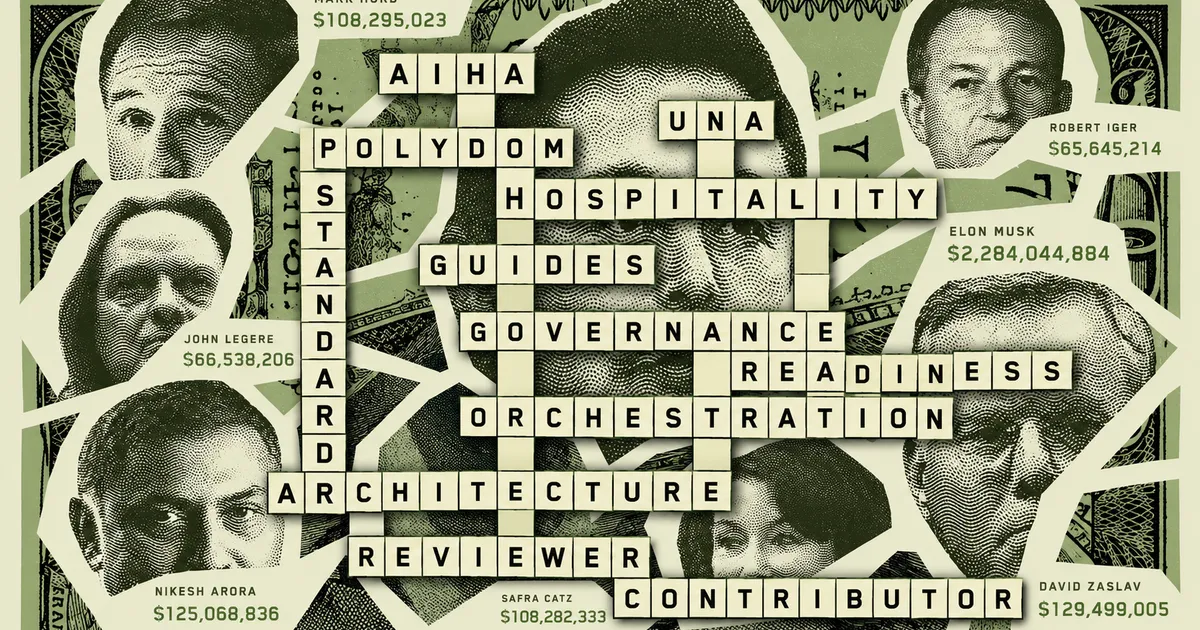
Five new industry guides published by the AI Hospitality Alliance (AIHA) now include officially credited contributions from Polydom’s leadership team. This milestone marks an important step in hospitality AI: moving from discussions about what artificial intelligence could do toward practical guidance on how it should be governed, connected, evaluated, and operated in real hospitality environments.
In July 2026, we announced Una by Polydom’s role as a Founding Partner of the AI Hospitality Alliance, joining an industry-wide effort to advance responsible AI adoption, interoperability, and shared technical standards.
Today, that collaboration is reflected in published resources available to the hospitality community.
Polydom Co-Founder & CEO Lana Udalov, who serves on the AIHA Advisory Board, has been officially credited as an External Reviewer of three guides. Polydom CTO Evgeny Chernyshov has been recognized as a Contributor to two technical frameworks.
Together, these five publications address some of the most important questions facing hotels as AI moves from experimentation into everyday operations.
Lana Udalov — External Reviewer
1. Agentic Protocols Adapted for Hospitality
Lana reviewed implementation clarity and attribution of proposed mechanisms, including how errors are explained across protocols and how independent hotels can connect the guidance with practical vendor questions.
The guide explores how emerging agentic technologies can interact with hospitality systems and why clearer implementation requirements matter for hotels evaluating AI solutions.
2. Hospitality AI Governance Framework
Lana provided an independent review from a hospitality technology perspective.
The framework addresses responsibility, oversight, human accountability, governance processes, and risk across hospitality AI deployments.
As AI becomes more deeply integrated into hotel operations, governance must extend beyond technical performance to include who remains responsible for decisions, how risks are managed, and when human intervention is required.
3. AI Readiness Guide for Hotels
Lana independently reviewed the guide and its readiness assessment from a hospitality technology perspective, helping assess its practical relevance to hotel teams considering AI adoption.
The guide supports hotels in evaluating their preparedness for AI implementation, including the organizational and operational considerations that should come before selecting or deploying new technology.
Evgeny Chernyshov — Contributor
4. AI Orchestration Framework for Hospitality
AIHA credits Evgeny’s contributions in production field notes, guarded execution patterns, guest-verification approaches, technical reviews, self-assessment tests, and a reusable deep-link proposal.
The framework examines how AI agents can interact with hotel systems through controlled execution paths, with attention to permissions, verification, and operational reliability.
These considerations become increasingly important when AI moves beyond answering questions and begins performing actions such as modifying reservations, updating records, or coordinating tasks.
5. Scalable AI Platform Architecture Blueprint for Hospitality
Evgeny contributed testable architecture principles, data prerequisites and vendor checks, reduced-service considerations, measurement and observability improvements, and technical editorial validation.
The blueprint addresses the architectural requirements for building reliable AI systems that can operate across different properties, technology environments, and operational conditions.
For hospitality organizations, scalability is not simply about supporting more users. It also means maintaining predictable behavior, clear integration boundaries, and dependable operations as systems become more interconnected.
Why These Standards Matter to Hospitality
For hotel operators, AI adoption is no longer only a question of whether an assistant can answer a guest correctly.
The more important question is what happens when that assistant needs to take action.
Can it modify a reservation safely? Does it know which system contains the authoritative information? Can it recognize when an operation requires approval? What happens when an integration fails, guest information is incomplete, or a request needs human judgment?
As AI systems take on more operational responsibilities, these questions become essential.
Hotels need clear responsibilities, reliable information sources, controlled permissions, measurable performance, and defined escalation routes to human teams.
This is where shared industry guidance becomes valuable.
Rather than leaving every hotel operator to evaluate AI technologies in isolation, the AIHA publications offer frameworks for understanding technical requirements, operational safeguards, governance responsibilities, and organizational readiness.
The five guides form part of the Alliance’s broader effort to establish more consistent approaches to hospitality AI.
Explore the published resources and additional industry guidance through the AI Hospitality Alliance Standards & Guides page.
Bringing Real Hospitality Operations Into the Conversation
At Polydom, our perspective is shaped by building Una, a voice-first AI digital employee designed to carry out hospitality workflows across guest communication, reservations, and operations.
Working with AI in operational environments raises challenges that are often less visible in demonstrations: incomplete data, system permissions, exceptions, integration dependencies, guest verification, and the need for reliable human handoffs.
These are not peripheral technical details. They determine whether an AI system can be trusted to perform useful work consistently.
Contributing practical experience to industry discussions is one way to help bridge the gap between high-level AI ambitions and the safeguards required in real hotel environments.
As we explored in our original announcement of Una by Polydom joining AIHA, meaningful industry standards require collaboration among organizations bringing different technologies, operational perspectives, and commercial interests to the table.
The publication of these five guides represents tangible progress in that direction.
Moving Hospitality AI Forward Together
We thank the AI Hospitality Alliance, its founder Ira Vouk, the workgroup members, reviewers, and contributors who helped bring these resources to the hospitality community.
Their collective work provides valuable starting points for hotel operators, technology providers, and industry professionals seeking to understand how AI can be implemented more responsibly and effectively.
We encourage hospitality organizations to explore the published guidance, evaluate its recommendations against their own operational requirements, and participate in the continuing conversation about AI standards.
Read the full collection: AI Hospitality Alliance — Standards & Guides
Learn more about Una by Polydom and explore additional perspectives in the Polydom Blog.
These publications are independent AIHA industry resources. Recognition of Polydom team members’ contributions does not constitute AIHA certification, endorsement, or approval of Una or any individual product.
Tagged